Doctor killed Beethoven - Pathologist
Updated: 2007-08-29 06:46
VIENNA, Austria - Did someone kill Beethoven? A Viennese pathologist claims the composer's physician did - inadvertently overdosing him with lead in a case of a cure that went wrong.
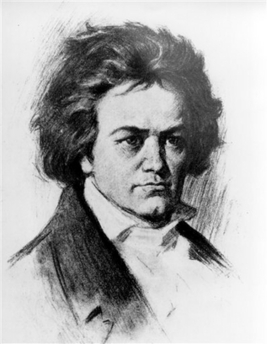 This is an undated sketch of German composer Ludwig van Beethoven. Beethoven was born in Bonn on Dec. 17, 1770 and died in Vienna on March 26, 1827. [AP] |
Other researchers are not convinced, but there is no controversy about one fact: The master had been a very sick man years before his death in 1827.
Previous research determined that Beethoven had suffered from lead poisoning, first detecting toxic levels of the metal in his hair and then, two years ago, in bone fragments. Those findings strengthened the belief that lead poisoning may have contributed - and ultimately led - to his death at age 57.
But Viennese forensic expert Christian Reiter claims to know more after months of painstaking work applying CSI-like methods to strands of Beethoven's hair.
He says his analysis, published last week in the Beethoven Journal, shows that in the final months of the composer's life, lead concentrations in his body spiked every time he was treated by his doctor, Andreas Wawruch, for fluid inside the abdomen. Those lethal doses permeated Beethoven's ailing liver, ultimately killing him, Reiter said.
"His death was due to the treatments by Dr. Wawruch," said Reiter, head of the Department of Forensic Medicine at Vienna's Medical University. "Although you cannot blame Dr. Wawruch - how was he to know that Beethoven already had a serious liver ailment?"
Nobody did back then.
Only through an autopsy after the composer's death in the Austrian capital on March 26, 1827, were doctors able to establish that Beethoven suffered from cirrhosis of the liver as well as edemas of the abdomen. Reiter says that in attempts to ease the composer's suffering, Wawruch repeatedly punctured the abdominal cavity - and then sealed the wound with a lead-laced poultice.
Although lead's toxicity was known even then, the doses contained in a treatment balm "were not poisonous enough to kill someone if he would have been healthy," Reiter said. "But what Dr. Wawruch clearly did not know that his treatment was attacking an already sick liver, killing that organ."
Even before the edemas developed, Wawruch noted in his diary that he treated an outbreak of pneumonia months before Beethoven's death with salts containing lead, which aggravated what researchers believe was an existing case of lead poisoning.
But, said Reiter, it was the repeated doses of the lead-containing cream, administered by Wawruch in the last weeks of Beethoven's life, that did in the composer.
Analysis of several hair strands showed "several peaks where the concentration of lead rose pretty massively" on the four occasions between Dec. 5, 1826, and Feb. 27, 1827, when Beethoven himself documented that he had been treated by Wawruch for the edema, said Reiter. "Every time when his abdomen was punctured ... we have an increase of the concentration of lead in the hair."
Such claims intrigue others who have researched the issue.
"His data strongly suggests that Beethoven was subjected to significant lead exposures over the last 111 days of his life and that this lead may have been in the very medicines applied by his doctor," said Bill Walsh, who led the team at the U.S. Department of Energy's Argonne National Laboratory outside Chicago that found large amounts of lead in Beethoven's bone fragments. That research two years ago confirmed the cause of years of debilitating disease that likely led to his death - but did not tie his demise to Wawruch.
"I believe that Beethoven's death may have been caused by this application of lead-containing medicines to an already severely lead-poisoned man," Walsh said.
Still, he added, samples from hair analysis are not normally considered as reliable as from bone, which showed high levels of lead concentration over years, instead of months.
With hair, "you have the issue of contamination from outside material, shampoos, residues, weathering problems. The membranes on the outside of the hair tend to deteriorate," he said, suggesting more research is needed on the exact composition of the medications given Beethoven in his last months of his life.
As for what caused the poisoning even before Wawruch's treatments, some say it was the lead-laced wine Beethoven drank. Others speculate that as a young man he drank water with high concentrations of lead at a spa.
"We still don't know the ultimate cause," Reiter said. "But he was a very sick man - for years before his death."
The Beethoven Journal is published by the Ira F. Brilliant Center for Beethoven Studies at San Jose State University in California.
|
|
|
||
|
||
|
|
|
|