US astronomers find a hole in the universe
Updated: 2007-08-25 10:36
WASHINGTON - American astronomers have stumbled upon a tremendous hole in the universe. That's got them scratching their heads about what's just not there.
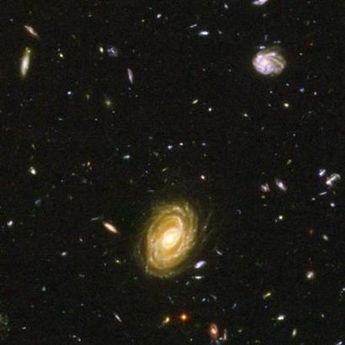
The cosmic blank spot has no stray stars, no galaxies, no sucking black holes, not even mysterious dark matter. It is 1 billion light years across of nothing. That's an expanse of nearly 6 billion trillion miles of emptiness, a University of Minnesota team announced Thursday.
 |
Astronomers have known for many years that there are patches in the universe where nobody's home. In fact, one such place is practically a neighbor, a mere 2 million light years away. But what the Minnesota team discovered, using two different types of astronomical observations, is a void that's far bigger than scientists ever imagined.
"This is 1,000 times the volume of what we sort of expected to see in terms of a typical void," said Minnesota astronomy professor Lawrence Rudnick, author of the paper that will be published in Astrophysical Journal. "It's not clear that we have the right word yet ... This is too much of a surprise."
Rudnick was examining a sky survey from the National Radio Astronomy Observatory, which essentially takes radio pictures of a broad expanse of the universe. But one area of the universe had radio pictures indicating there was up to 45 percent less matter in that region, Rudnick said.
The rest of the matter in the radio pictures can be explained as stars and other cosmic structures between here and the void, which is about 5 to 10 billion light years away.
Rudnick then checked observations of cosmic microwave background radiation and found a cold spot. The only explanation, Rudnick said, is it's empty of matter.
It could also be a statistical freak of nature, but that's probably less likely than a giant void, said James Condon, an astronomer at the National Radio Astronomy Observatory. He wasn't part of Rudnick's team but is following up on the research.
"It looks like something to be taken seriously," said Brent Tully, a University of Hawaii astronomer who wasn't part of this research but studies the void closer to Earth.
Tully said astronomers may eventually find a few cosmic structures in the void, but it would still be nearly empty.
Holes in the universe probably occur when the gravity from areas with bigger mass pull matter from less dense areas, Tully said. After 13 billion years "they are losing out in the battle to where there are larger concentrations of matter," he said.
Retired NASA astronomer Steve Maran said of the discovery: "This is incredibly important for something where there is nothing to it."
|
|
|
||
|
||
|
|
|
|