America
Astronomers spot exploding faraway star
(AP)
Updated: 2007-05-08 06:35
 |
Large Medium Small |
This artist's illustration provided by NASA shows what the brightest supernova ever recorded, known as SN 2006gy, may have looked like when it exploded.?[AP] |
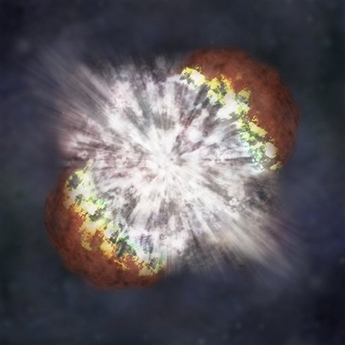
Using a variety of Earth and space telescopes, astronomers found a giant exploding star that they figure has shined about five times brighter than any of the hundreds of supernovae ever seen before, said discovery team leader Nathan Smith of the University of California at Berkeley. The discovery was first made last September by a graduate student in Texas.
"This one is way above anything else," Smith told The Associated Press. "It's really astonishing."
Smith said the star, SN2006gy, "is a special kind of supernova that has never been seen before." He called the star "freakily massive" at 150 times the mass of the sun.
Observations from the Chandra X-ray telescope helped show that it didn't become a black hole like other supernovae and skipped a stage of star death.
Unlike other exploding stars, which peak at brightness for a couple of weeks at most, this supernova, peaked for 70 days, according to NASA. And it has been shining at levels brighter than other supernovae for several months, Smith said.
And even at 240 million light years away, this star in a distant galaxy does suggest that a similar and relatively nearby star — one 44 quadrillion miles away — might blow in similar fashion any day now or 50,000 years from now, Smith said. It wouldn't threaten Earth, but it would be so bright that people could read by it at night, said University of California at Berkeley astronomer David Pooley. However, it would only be visible to people in the Southern Hemisphere, he said.
| 分享按鈕 |