US military says Iran helping Iraq
(AP)Updated: 2007-04-11 20:57
BAGHDAD - Iran has been training Iraqi fighters in the assembly of deadly roadside bombs known as EFPs, the US military spokesman said Wednesday.
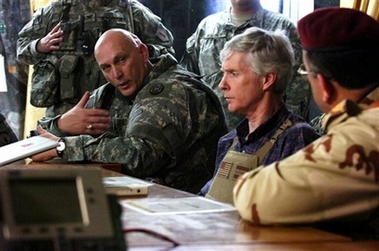 In this image released by the US Army on Wednesday April 11, Lt. Gen. Ray Odierno, commander of Multi-National Corps Iraq, left, talks about security conditions in Dora neighborhood in Baghdad, Iraq, as Ryan Crocker, United States ambassador to Iraq, and Brig. Gen. Gazwan Sharif Abed al Hamid, commander of the 6th Brigade, 2nd Iraqi National Police Division, look on Thursday, April 5, 2007. [AP]  |
"We know that they are being in fact manufactured and smuggled into this country, and we know that training does go on in Iran for people to learn how to assemble them and how to employ them," Maj. Gen. William Caldwell said at a weekly briefing. "We know that training has gone on as recently as this past month from detainees' debriefs."
In January, US officials said at least 170 US soldiers had been killed by EFPs.
The international Red Cross released a report that found the situation for civilians in Iraq is "ever-worsening," even though security in some places has improved as a result of stepped-up efforts by US-led multinational forces.
Bodies lay scattered across two central Baghdad neighborhoods after a raging battle left 20 suspected insurgents and four Iraqi soldiers dead, and 16 US soldiers wounded, witnesses and officials said. The fighting Tuesday in Fadhil and Sheik Omar, two Sunni enclaves, was the most intense since a massive push to pacify the capital began two months ago.
Iraqi Cabinet ministers allied to radical cleric Muqtada al-Sadr meanwhile threatened Wednesday to quit the government to protest the prime minister's lack of support for a timetable for US withdrawal.
Such a pullout by the very bloc that put Prime Minister Nouri al-Maliki in office could collapse his already perilously weak government. The threat comes two months into a US effort to pacify Baghdad in order to give al-Maliki's government room to function.
Al-Sadr's political committee issued a statement a day after al-Maliki rejected an immediate US troop withdrawal.
"We see no need for a withdrawal timetable. We are working as fast as we can," al-Maliki told reporters during his four-day trip to Japan, where he signed loan agreements for redevelopment projects in Iraq.
"To demand the departure of the troops is a democratic right and a right we respect. What governs the departure at the end of the day is how confident we are in the handover process," he said, adding that "achievements on the ground" would dictate how long American troops remain.
Al-Maliki spoke a day after tens of thousands of Iraqis took to the streets of two Shiite holy cities, on al-Sadr's orders, to protest the US presence in their country. The rally marked the fourth anniversary of Baghdad's conquer by American forces.
"The Sadrist movement strongly rejects the statements of Prime Minister Nouri al-Maliki, in which he stood by the continued presence of occupation forces despite the will of the Iraqi people," said the statement, a copy of which was obtained by The Associated Press.
"The Sadrist movement is studying the option of withdrawing from the Iraqi government - a government that has not fulfilled its promises to the people," it said.
"We are serious about withdrawing," it added.
It would not be the first time the Sadrists, who hold six seats in the Cabinet, left al-Maliki's government. Al-Sadr's ministers and 30 legislators boycotted the government and parliament for nearly two months to protest a November meeting between al-Maliki and President Bush in Jordan.
The statement expressed anger over the Baghdad security plan launched on Feb. 14, calling it "unfair." Iraqi and US troops have been targeting members of al-Sadr's Mahdi Army militia, which has been blamed for sectarian killings.
Caldwell also said the US military had evidence that Iranian intelligence agents were active in Iraq in funding, training and arming Shiite militia fighters.
"We also know that training still is being conducted in Iran for insurgent elements from Iraq. We know that as recent as last week from debriefing personnel," he said.
Caldwell added that fighters also were trained in how to carry out complex attacks that used explosives followed by assaults with rocket-propelled grenades and small arms.
"There has been training on specialized weapons that are used here in Iraq.
And then we do know they receive also training on general tactics in terms of
how to take and employ and work what we call a more complex kind of attack where
we see multiple types of engagements being used from an explosion to small arms
fire to being done in multiple places," Caldwell said.
| 1 | 2 |  |
|
||
|
||
|
|