Asia-Pacific
Papers tie US to 1950s Japan coup plot
(AP)
Updated: 2007-03-01 07:30
 |
Large Medium Small |
|
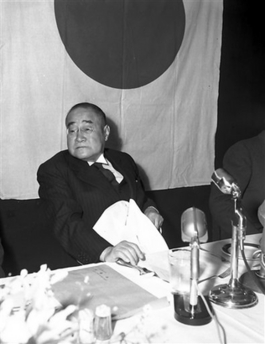
Former Japanese Prime Minister Shigeru Yoshida appears in Tokyo in this April 28, 1955 file photo. [AP] |
TOKYO - Declassified documents reveal that Japanese ultranationalists with ties to U.S. military intelligence plotted to overthrow the Japanese government and assassinate the prime minister in 1952.
The scheme — which was abandoned — was concocted by militarists and suspected war criminals who had worked for U.S. occupation authorities after World War II, according to CIA records reviewed by The Associated Press. The plotters wanted a right-wing government that would rearm Japan.
The CIA files, declassified in 2005 and publicized by the U.S. National Archives in January, detail a plot to oust the pro-U.S. prime minister, Shigeru Yoshida, and install a more hawkish government led by Ichiro Hatoyama.
The CIA, in papers released under an act of the U.S. Congress to declassify documents related to Japanese war crimes, said the plotters were led by Takushiro Hattori, a former private secretary to Hideki Tojo, the wartime prime minister hanged as a war criminal in 1948.
Two CIA documents said the plot reportedly had the support of 500,000 people in Japan, and that the group planned to use a contact who controlled a faction inside the National Safety Agency — a precursor to the Defense Ministry — to help launch the coup.
The files reviewed by the AP strongly suggest the Americans were unaware of the plot until after it had been dropped. The plot was developed after the U.S. postwar occupation of Japan ended in April 1952, and the CIA files say American financial support for Hattori's group had dried up by then.
Still, the documentary evidence of the plot illustrates the violent potential of the right-wing, anti-communist cabal that had worked under the U.S. occupation authority's "G-2" intelligence wing in the early days of the Cold War in the late 1940s and early 50s. The CIA operated separately from the G-2.
"Since the beginning of July 1952, plans for a coup d'etat have been initiated among a group of ex-purgees including former military officers. The leader of the group is ex-Colonel Hattori Takushiro," said an Oct. 31, 1952 report, which claimed "this report is the first to mention a definite rightist plan involving violence."
"The original plan of the group was to engineer a coup d'etat, including the assassination of Prime Minister Yoshida Shigeru on account of his hostile attitude toward depurgees and nationalists," the CIA document said.
According to the document, Hattori colleague Masanobu Tsuji talked the group out of the coup, urging it to focus instead on countering the Socialist Party. The files say the group then decided it would not stage a coup as long as Yoshida's conservative Liberal Party remained in power.
However, the group still considered violence an option, the files say.
"The group is considering the possibility of some minor assassination attempt in lieu of a coup d'etat," the Oct. 31, 1952 document said.
Hattori and others had worked under the aegis of Maj. Gen. Charles Willoughby, the anti-communist G-2 chief. During the occupation, Willoughby was considered the second most powerful American after his boss, Gen. Douglas MacArthur.
Some group members were considered choice war crimes trial targets after the war.
Tsuji had been wanted for involvement in the Bataan Death March of 1942, in which thousands of Americans and Filipinos perished. Another group associate was Yoshio Kodama, a war profiteer and mob boss who was deeply involved in procuring materials — often illegally — for the Japanese military machine.
Neither of them was prosecuted for war crimes.
The Japanese militarists joined U.S.-supported missions to spy on communists in Japan, infiltrate agents into Soviet and North Korean territory, and recruit Japanese mercenaries to protect Taiwan from communist forces in mainland China, declassified documents show.
The CIA files, however, say the operations were riddled with intelligence leaks, hobbled by a lack of competent agents, and deeply compromised by rivalries among the rightists themselves. The agents' top priorities, the documents say, were profits and an eventual resurgence of a militarist Japan.
The assassination plot detailed in the CIA files came at a difficult time for Hattori's group.
The departure of Willoughby from Japan in 1951 as the U.S. occupation wound down deprived the rightists of their leading American patron and paymaster. Meanwhile, Yoshida was openly hostile to Hattori's push for rearmament.
"The government attitude toward the Hattori group has been increasingly antagonistic, and the group has lost influence since the departure of General Willoughby," said a CIA document dated April 18, 1952.
Yoshida was pushed out of office peacefully in 1954 and replaced by Hatoyama, but the ultrarightist dream of resurrecting a militarist Japan never happened. The 1947 pacifist constitution bars Japan from warfare and has never been amended.
| 分享按鈕 |