UN agency halts some Iran aid
(AP)Updated: 2007-01-18 09:20
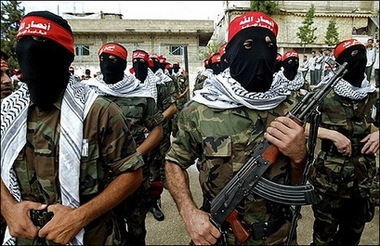 Hooded armed Palestinian militants from Ansarollah group take part in a military parade in Sidon, Lebanon, October 2006.[AFP]  |
| |||

A UN official and a diplomat accredited to the IAEA said the suspension was imposed in recent days. Both spoke to The Associated Press on condition of anonymity because they were not authorized to comment on the issue to the media.
Another diplomat said the aid was suspended for programs "where there is a clear prohibition by the Security Council, specifically applying to enrichment, reprocessing and heavy water (production)." He said the agency planned to separate the projects into those where Security Council bans applied, those deemed uncontroversial and a "gray list" of projects that need closer examination as to whether they could be used in weapons production.
"Whatever is absolutely clearly banned by the resolution is now on hold," he added.
The agency's decision to temporarily shelve some projects even before a final decision by the board was interpreted by some diplomats who deal with the Vienna-based IAEA as a victory for the United States.
Washington is the key critic of Tehran's refusal to suspend uranium enrichment. While Tehran says it wants to develop an enrichment program to generate energy, the Americans say the Islamic republic is more interested in the program's other application - creating the fissile core of nuclear warheads.
Still, a US push to halve IAEA aid to Iran as part of Security Council sanctions is facing opposition from traditional US allies in the European Union as well as from developing nations, diplomats said. Such European opposition is worrisome from Washington's point of view because it could dilute attempts to present a unified Western front against Iran's nuclear defiance.
Iran gets IAEA technical aid for more than 15 projects and dozens more that also involve other countries. Diplomats familiar with American strategy for the next IAEA board meeting March 5 say Washington wants at least half of the aid projects permanently eliminated.
But that is opposed by Germany, which holds the rotating European Union presidency, and many other EU nations. The diplomats said that - unless Washington moderates its stance - confrontation is inevitable at the March meeting.
The United States, Russia, China, Britain, France and Germany all want Iran to mothball its enrichment program and have acted as a group in trying to engage Tehran on the issue. But their approaches and priorities have differed over the past year - resulting in often visible strains in what is meant to be a joint initiative.
Russian and Chinese reluctance to slap harsh sanctions on Tehran - as initially demanded by Washington - have created the greatest pressures. Both nations share economic and strategic interests with Iran
But problems also have surfaced in the ranks of European allies, with Germany traditionally the least hawkish and the French recently nudging the British aside to become the most loyal European backers of the Americans.
Differences over how severely to punish Tehran for its refusal to suspend enrichment led to months of disputes before agreement was reached last month on a Security Council resolution imposing limited sanctions that fell short of the harsher measures the Americans had pushed for.
The sanctions include a review of technical aid to Iran - programs meant to bolster the peaceful use of nuclear energy in medicine, agriculture or power generation.
In November, the board of the agency indefinitely suspended an IAEA project that would have helped Iran put safety measures in place for a heavy water reactor that, once completed, will produce plutonium - like enriched uranium, a potential pathway to nuclear arms. That decision, however, was relatively straightforward, considering the Security Council had already indirectly called for an end to construction of the reactor.
In contrast, most of the projects up for review at the March meeting are for programs that have less obvious potential weapons applications.
They include cancer therapy programs, nuclear safety projects and requests for help in international nuclear licensing procedures.
| ||
|
||
|
||
|
|