Skull suggests human-Neanderthal link
(AP)Updated: 2007-01-16 08:55
WASHINGTON - A skull found in a cave in Romania includes features of both modern humans and Neanderthals, possibly suggesting that the two may have interbred thousands of years ago.
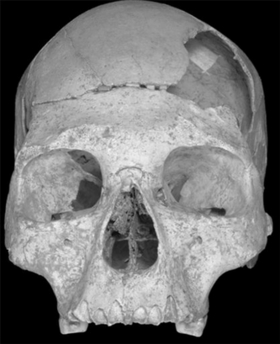 This skull, ffound in Pestera cu Oase - the Cave with Bones - in southwestern Romania, includes features of both modern humans and Neanderthals, possibly suggesting that the two hominid species may have interbred thousands of years ago. The skull is discussed in a paper by Erik Trinkaus of Washington University in St. Louis. The report appears in Tuesday's issue of Proceedings of the National Academy of Sciences. [AP]  |
The skull bearing both older and modern characteristics is discussed in a paper by Erik Trinkaus of Washington University in St. Louis. The report appears in Tuesday's issue of Proceedings of the National Academy of Sciences.
The skull was found in Pestera cu Oase - the Cave with Bones - in southwestern Romania, along with other human remains. Radiocarbon dating indicates it is at least 35,000 years old and may be more than 40,000 years old.
The researchers said the skull had the same proportions as a modern human head and lacked the large brow ridge commonly associated with Neanderthals. However, there were also features that are unusual in modern humans, such as frontal flattening, a fairly large bone behind the ear and exceptionally large upper molars, which are seen among Neanderthals and other early hominids.
"Such differences raise important questions about the evolutionary history of modern humans," said co-author Joao Zilhao of the University of Bristol, England.
It could reflect a case in which ancient traits reappear in a modern human, or it could indicate a mixture of populations, Zilhao said. Or it simply may be that science hasn't been able to study enough early modern people to understand their diversity.
Dr. Richard Potts of the Smithsonian's National Museum of Natural History noted that the skull represents the earliest modern human ever found in Europe.
It's a big deal in that sense, he said, but the combination of characteristics don't necessarily indicate interbreeding between populations.
Overall there is no strong evidence for mixing of Neanderthal and modern human populations and "this doesn't add any," said Potts, who wasn't part of the research team.
None of the features cited as unusual in modern humans is exclusively Neanderthal, Potts said. Rather, they could be features passed down from earlier populations in Africa.
The field work that uncovered the skull was conducted in 2004 and 2005.
Meanwhile, a research team led by Svante Paabo of the Max Planck Institute for Evolutionary Anthropology in Leipzig, Germany, is trying to map the Neanderthal genome in hopes of better understanding any possible relationship to modern people.
The research was funded by the US National Science Foundation, the Wenner-Green Foundation, Washington University, the Leakey Foundation, the Portuguese Institute of Archaeology, the Royal Belgian Institute of Natural Science, the Romanian National Council for Academic Research and the Foundation Fyssen.
|
||
|
||
|
|