Engineered chickens make cancer drugs
(Reuters)Updated: 2007-01-15 10:45
WASHINGTON - A team at the institute that cloned Dolly the sheep have made a genetically engineered chicken that produces cancer drugs in its eggs.
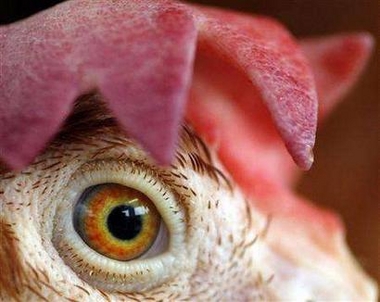 File photo shows a chicken during a bird flu preparedness exercise in Singapore on October 4, 2006.[Reuters]  |
The drugs include a monoclonal antibody - themselves lab-engineered immune system proteins - and a human immune system protein used to treat cancer and other conditions, the researchers report in the upcoming issue of the Proceedings of the National Academy of Sciences.
These drugs are not easy to make in the lab. "Many human therapeutic proteins, such as monoclonal antibodies, are produced in industrial bioreactors, but setting up such systems is both time-consuming and expensive," the researchers wrote.
Scientists have been trying to find good ways to turn animals into factories instead - given that animals naturally make such proteins anyway.
Cattle, sheep and goats all have been genetically engineered to produce human proteins in their milk, including insulin and drugs to treat cystic fibrosis, but the Roslin team thought chickens, with their shorter life cycles and egg-laying prowess, also might be useful.
Helen Sang and colleagues at Roslin made the genetically engineered or transgenic hens by inserting the genes for the desired proteins into the hen's gene for ovalbumin, a protein that makes up half of egg whites.
They wanted to ensure the hens made the proteins in their egg whites and nowhere else.
The proteins they chose were miR24, a monoclonal antibody with potential for treating melanoma, and human interferon b-1a, an immune system protein from a family of proteins that attacks tumours and viruses.
They used a virus to infect very early chicken embryos. The virus inserted the genetic material into the DNA of chick embryos in newly laid eggs.
The researchers hatched these chicks and found the male chicks who had indeed incorporated the new DNA in their semen.
These cockerels were then bred with normal hens and they screened the resulting chicks to see which ones still carried the two new genes. The researchers have now bred several hundred chickens that can produce the desired proteins.
They worked with Viragen (Scotland) Ltd., a subsidiary of the US biotechnology company Viragen and Oxford Biomedica Ltd.
Other companies have created animals and plants that produce human and animal proteins, as well as vaccines.
|
||
|
||
|
|