Gates set to take over at Pentagon
(AP)Updated: 2006-12-18 20:33
WASHINGTON - Robert Gates will take over as secretary of defense at a crucial juncture in the Iraq war, a conflict that cost Donald H. Rumsfeld his job and likely will define Gates' Pentagon tenure.
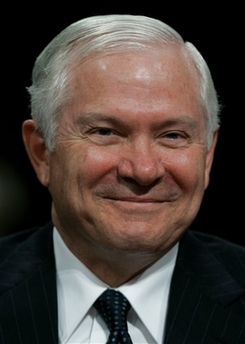 Robert Gates, President Bush's choice to replace Donald H. Rumsfeld as defense secretary, smiles during his Senate confirmation hearing on Capitol Hill in Washington, Tuesday, Dec. 5, 2006. Gates is taking over as secretary of defense at a crucial juncture in the Iraq war, a conflict that cost Rumsfeld his job and likely will define Gates' Pentagon tenure. [AP]  |
Gates will take the oath of office Monday in a private event at the White House, then heading to a public swearing-in ceremony at the Pentagon, where the military brass and senior civilian officials are eager to see what changes he may bring.
When President Bush announced last month that he was switching Pentagon chiefs, he said he wanted "fresh perspective" on Iraq, acknowledging the current approach was not working well enough. Rumsfeld was a chief architect of the war strategy and still defends the decision to invade in March 2003.
Gates, 63, takes office amid a wide-ranging administration review of its approach to the war. Bush said last week that he would wait until January to announce his new strategy, to give Gates a chance to offer advice.
Besides the wars in Iraq and Afghanistan, Gates faces other immediate challenges. One is the Army's proposal that it be allowed to grow by tens of thousands of soldiers, given the strains it is enduring from the two wars. Rumsfeld had resisted increasing the size of the Army or the Marine Corps; Gates' view is unknown.
Gates said at his Senate confirmation hearing Dec. 5 that he intends to travel to Iraq "very soon" after being sworn in, so he could consult with senior US commanders about how to adjust US strategy. He also raises some eyebrows by saying, when asked whether the US was winning in Iraq, "No, sir."
It's not yet clear whether Gates intends to immediately shake up the Pentagon by firing generals or replacing senior civilian officials. He has asked Gordon England, the deputy defense secretary, to remain, but some have already announced their departures, including the top intelligence official, Stephen Cambone.

"He's extremely capable," said Barry McCaffrey, a retired Army general and one of Rumsfeld's loudest critics.
John Douglass, president of the Aerospace Industries Association of America, called Gates a "breath of fresh air."
Rumsfeld told Pentagon employees at a going-away ceremony that he expected Gates to do a good job.
At his confirmation hearing, Gates won plaudits for his candor.
Urged by Sen. Edward Kennedy, the Massachusetts Democrat who is among the most vocal critics of the Iraq war strategy, to "be a standup person" with the courage to push a war policy worthy of the sacrifices endured by troops and their families, Gates assured the committee that he had no intention of going to the Pentagon to be a "bump on a log."
He pledged to speak candidly and boldly to the president and Congress about what he thinks needs to be done in Iraq. He was a member of the Iraq Study Group that spent nine months assessing the situation in Iraq and produced recommendations that include phasing out most US combat troops by 2008. Gates left the commission when Bush announced that he had been picked to replace Rumsfeld.
"In my view, all options are on the table, in terms of how we address this problem in Iraq," Gates said at his confirmation hearing.
Asked point-blank by Sen. Carl Levin, D-Mich., whether the US is winning in Iraq, Gates replied, "No, sir." That contrasted with Bush's remark at an Oct. 25 news conference that, "Absolutely, we're winning."
Gates, a Kansas native, joined the CIA in 1966. He left in 1974 to join the staff of the National Security Council until 1979, when he returned to the spy agency. He rose to deputy director for intelligence in 1982.
His 1987 nomination to head the CIA was scuttled when he was accused of knowing more than he admitted about the Iran-Contra affair. The Reagan administration secretly had sold arms to Iran in hopes of freeing hostages in Lebanon, and used the money to help the Contra rebels in Nicaragua.
Gates went to the White House as President Reagan's deputy national security adviser in 1989, then took over the CIA in 1991. He left Washington in 1993 and since August 2002 has been president of Texas A&M University.
|
||
|
||
|
|