Bush says new approach needed in Iraq
(AP)Updated: 2006-12-08 08:52
WASHINGTON - US President Bush, admitting that "it's bad in Iraq," acknowledged Thursday that the United States needs a new approach in the unpopular war and promised to unveil details in an upcoming speech.
|
|
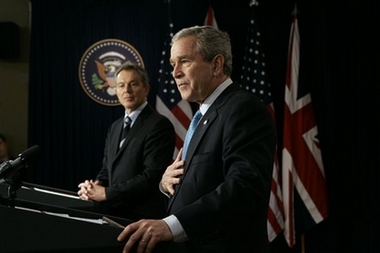

"I do know that we have not succeeded as fast as we wanted to succeed," Bush said, standing alongside British Prime Minister Tony Blair, his chief ally in the war. "I do understand that process is not as rapid as I had hoped."
Bush's meeting with Blair came a day after the Iraq Study Group headed by former Secretary of State James A. Baker III and former Democratic Rep. Lee Hamilton issued a stinging report saying the Bush policies in Iraq had failed and a major course correction was needed, including beginning to withdraw combat troops.
Bush said the study group's report would be an important part of his considerations. He said he was awaiting results of internal reviews being done at the Pentagon, State Department and the White House and would deliver a speech to the nation on Iraq in coming weeks after he decides on a new course.
The study group concluded that a stable, democratic Iraq was still possible, but Baker said: "We do not know if it can be turned around."
Bush was more upbeat, but gave no hints about whether he was contemplating a major policy shift. At the same time, Bush said that he didn't think Baker and Hamilton "expect us to accept every recommendation."
"It makes sense to analyze the situation and to devise a set of tactics and strategies to achieve the objective that I have stated," Bush said. "And so, if the present situation needs to be changed, it follows that we'll change it if we want to succeed."
The report, which warns that the situation in Iraq is "grave and deteriorating," contains 79 separate recommendations. They call for a gradual withdrawal of U.S. combat forces during the next year to ramp up the training of Iraqi security forces. There are currently some 135,000 US soldiers and 7,100 British soldiers serving in Iraq.
Both Bush and Blair said that supporting the government of Iraqi Prime Minister Nouri al-Maliki was central to efforts to help Iraq defend, govern and sustain itself. They both urged al-Maliki to do more to assert control and quell violence.
Bush was asked whether he thought the study group suggested that he did not appreciate the extent of the violence in Iraq.
"It's bad in Iraq. That help?" retorted Bush.
"You know, in all due respect, I've been saying it a lot," Bush continued. "I understand how tough it is and have been telling the American people how tough it is. And they know how tough it is."
Another recommendation from the study group calls for enlisting diplomatic help from Iraq's neighbors, including Iran and Syria - not only to resolve problems in Iraq but to find an end to the long-running conflict between Israel and the Palestinians.
One of the study group's central recommendations was for the administration to reach out to Syria and Iran for help in stabilizing Iraq, a course Bush has rejected in the past and confronted skeptically on Thursday.
"Countries that participate in talks must not fund terrorism, must help the young democracy survive, must help with the economics of the country," Bush said. "If people are not committed, if Syria and Iran is not committed to that concept, then they shouldn't bother to show up."
For his part, Blair suggested that Iran's support for Shiite militants in southern Iraq presented a problem. "Iran has been ... basically arming, supporting, financing terrorism," the visiting British leader said.
Blair said he welcomed the Baker-Hamilton report despite its depiction of a failed policy that both he and Bush had previously embraced.
"It offers a strong way forward. I think it is important now we concentrate on the elements that are necessary to make sure that we succeed - because the consequences of failure are severe," Blair said.
Bush appeared to endorse the bipartisan panel's conclusion that any resolution of the Iraq conflict is tied to reducing tensions between Israel and the Palestinians and across the broader Middle East - a position Blair has long held.
"It's a tough time and its a difficult moment for America and Great Britain and the task before us is daunting," Bush said as members of the bipartisan commission testified about their report on Capitol Hill.
Blair said the terrorists' threat in Iraq is part of an old pattern that is region-wide. Terrorism "has basically come out of the Middle East" and must be addressed in a way that includes a solution to the Palestinian-Israeli conflict, he said.
|
||
|
||
|
|