Analysis: Verdict may not stop violence
(AP)Updated: 2006-11-06 14:38
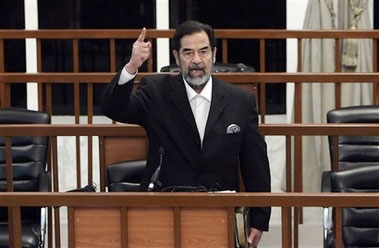 Former Iraqi President Saddam Hussein yells at the court as the verdict is delivered during his trial held under tight security in Baghdad's heavily fortified Green Zone, Sunday November 5, 2006. Iraq's High Tribunal on Sunday found Saddam Hussein guilty of crimes against humanity and sentence him to die by hanging. [AP]  |
AMMAN, Jordan - The future of Iraq may depend little on whether Saddam Hussein hangs. The Sunni insurgency is so deeply entrenched and sectarian bloodlust so strong that Iraq seems set to continue spiraling into violence -- regardless of its former president's fate.
Some fear that the Saddam verdict, by angering the Sunni minority, could intensify the violence once a curfew in Baghdad is lifted. Others say they hope the verdict gives Iraqis a chance "to unite and build a better future," in the words of the US Ambassador to Iraq, Zalmay Khalilzad.
But in the end, Saddam's fate is not what's driving the violence in Iraq now. Instead, religious, nationalistic and sectarian passions have taken over and are tearing the country apart.
Even if it causes a spasm of violence, Saddam's verdict is just a symbol of the deeper, underlying problems. Sunnis are alarmed at the prospect of Shiite domination. Shiites are fed up with attacks by Sunni extremists.
Without an effective government to protect them, both communities have become locked in a murderous cycle of reprisal killings that looks set to continue.
The insurgency started with Saddam loyalists.
But it long ago expanded into a multi-faceted conflict waged by different groups with different goals: nationalists seeking to drive foreigners from Iraqi soil; Sunni militants fearing domination by the Shiites; and religious zealots waging a global jihad against America.
The death of Saddam would matter little to religious extremists, for example, willing to sacrifice their own lives for their cause.
Likewise with the sectarian violence that has pushed the country to the brink of civil war. It started when Sunni insurgents began attacking Shiite civilians, considering them collaborators with the Americans.
With US and Iraqi forces unable to stop those attacks, Shiite militias took the law into their own hands, sending death squads to exact vengeance on Sunni civilians. Since the bombing of a Shiite shrine in Samarra in February, sectarian reprisal killings have spiraled out of control.
Those hatreds will continue to drive the violence -- regardless of what happens to Saddam. Neither the Americans nor their Iraqi partners have found a way to control them.
It's not that Saddam's fate has no effect at all: The sectarian fighting has, indeed, served to boost his image among many of his fellow Sunnis, even those who were happy to see him ousted from power three years ago.
With their minority community under siege since they were ousted from decades of power, many Sunnis have rallied around Saddam, forgetting the abuses suffered by all communities under his hard-line rule.
Thus, Saddam's execution could turn him into a martyr for some Sunnis, who consider the trial simply a smokescreen for the failures of the Americans and their Shiite and Kurdish allies.
"I believe that this trial is politically motivated and not a judicial one," said hardline Sunni cleric Harith al-Dhari. "If Saddam is charged with crimes, then the trial should be postponed until the occupation ends."
But the fact is that Sunnis are likely to remain unhappy even if Saddam were to live. It is their diminished role in the post-Saddam Iraq that most distresses them.
Saddam also matters, without question, to the majority Shiites: The violence has reinforced the determination of the Shiites and Kurds, who suffered immensely under Saddam's brutal rule, to put an end to any chance that the former regime might make a comeback.
Prime Minister Nouri al-Maliki, a Shiite, hailed the verdict, proclaiming that it marks "the end of a dark era and a beginning a new epoch" where the rule of law "will be supreme."
Yet al-Maliki's real problem is the burgeoning civil war -- and he will make little progress at any unified government, much less a united country, until he can convince Sunnis that they have a future in the new Iraq.
In short, until Iraq's communities reach political agreement on the future of their country, chances for peace appear bleak.
And that could take a very long time.
"You need to look at it in the long term and in the long term, I think the Iraqi people are going to be proud that they gave (Saddam and his defendants) a fair trial," said Christopher Reid, who served as an adviser to the Iraqi court.
But, he adds, acknowledging the current violence: "You can't look at this thing in the short term."
|
||
|
||
|
|