VIENNA, Austria - The five permanent members of the U.N. Security Council
agreed Wednesday to start working on U.N. sanctions against Iran next week, but
failed to bridge differences on how harsh the penalties should be, diplomats and
officials said.
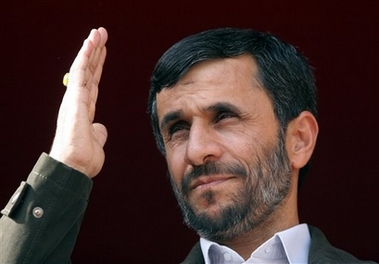
Iran's president Mahmoud Ahmadinejad,
gestures as he greets his supporters during his visit to the city of
Shahriar, 30 kilometers (18 miles) southwest of Tehran, Iran, Wednesday,
Oct. 11, 2006. [AP] |
They told The Associated Press that while the U.S. called for broad sanctions
to punish Iran's defiance in pursuing its nuclear program, Russian and Chinese
representatives at a top-level Vienna meeting favored less severe measures.
The diplomats and government officials demanded anonymity in exchange for
discussing the confidential meeting of the five Security Council countries and
Germany - the six powers whose repeated attempts to entice Iran to enter
negotiations finally broke down last week over Tehran's refusal to give up
uranium enrichment.
In New York, U.S. Undersecretary of State Nicholas Burns told the Council on
Foreign Relations that package of incentives meant to persuade Iran to halt
uranium enrichment remained on the table.
But he said Iran's stance left little choice but to "head back to the
Security Council in a couple of days, at the end of this week or early next ...
to begin the process of writing and then passing, we hope, a sanctions
resolution that will raise the cost to the Iranians of what they are doing in
the nuclear round."
Reflecting the importance of the meeting of the six powers, Russia, Britain,
France and Germany sent top negotiators directly answerable to their foreign
ministers, while the U.S. and China were represented by their chief
representatives to the Vienna-based International Atomic Energy Agency. Burns
participated via video hookup.
One of the diplomats, who had been briefed on the substance of the meeting,
said that while Burns had urged broad sanctions, such as a total ban on missile
and nuclear technology sales - the Russians and Chinese backed prohibitions of
selected items as a first step.
He also said the Chinese and Russian envoys called for renewed negotiations
with the Iranians in parallel to working on sanctions to punish Tehran for
defying a Security Council demand that it freeze enrichment, a possible pathway
to nuclear arms.
Burns told the Council on Foreign Relations that the countries trying to stop
Iran's programs "had come to a fork in the road." Despite a substantial package
of incentives and an offer of direct negotiations with the United States, Iran
"turned us down," he said.
"If at any time the Iranians wish to come forward and negotiate with the
United States and these other countries, then we'll be very happy to do so,"
Burns said.
The differences among the Security Council powers reflected continued
divisions over how harshly to penalize the Islamic republic for ignoring a
Security Council deadline to stop all enrichment activities by the end of
August.
"All agree for the need for sanctions but there are problems with how harsh
they should be," said one of the diplomats, whose country is accredited to the
International Atomic Energy Agency, or IAEA.
He said the meeting did not discuss North Korea and its claim to have tested
a nuclear bomb, but all participants agreed juggling two nuclear crises
complicated international nonproliferation efforts.
Iran, OPEC's No. 2 producer of crude, is apparently ready to face the threat
of sanctions because it is confident they will be more symbolic than damaging
because of international concerns any tough penalties could prompt Tehran to
retaliate by cutting off oil exports.
Restating his country's defiance, Iranian President Mahmoud Ahmadinejad was
quoted by state television Wednesday as saying "the day sanctions are imposed on
Iran by its enemies would be a day of national celebration for the Iranian
nation."
In separate comments earlier, Ahmadinejad called the prospect of sanctions "a
hollow threat."
"These three or four countries are bullying, they have no right to
intervene," he said, in reference to the United States, France, Britain and
Germany. "The Security Council has no right to intervene."
The Security Council demanded a halt to enrichment after the Iran ignored
calls from the IAEA to suspend such activities until doubts about the country's
nuclear program have been cleared. Uranium must be enriched before it can be
used in either nuclear reactors or atomic weapons. Iran says its nuclear program
is for peaceful purposes only.
Senior EU negotiator Javier Solana had met with top Iranian negotiator Ali
Larijani over the past few weeks in a new attempt to persuade Tehran to suspend
enrichment and start nuclear talks with the six-nation alliance.
But those talks failed last week over Iran's refusal to freeze enrichment
even for a limited time.
While the representatives of five of the six nations at the Vienna talks
subsequently met with IAEA chief Mohamed ElBaradei, the Americans did not
attend, said a U.N. diplomat.
There was no reason given for their absence, but one of the diplomats
speculated it could have been a show of U.S. displeasure with ElBaradei, whom
Washington in the past has accused of being too soft on Iran.
