BAGHDAD - The second trial of Saddam Hussein, on
charges of genocide in connection with a crackdown on Kurds, resumed Monday
after a 19-day hiatus with the former Iraqi leader in the courtroom.
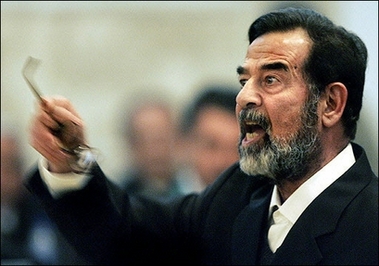
Saddam Hussein argues
with the chief judge while testifying during his trial in Baghdad in March
2006. US Secretary of State Condoleezza Rice insisted that Al-Qaeda
operatives in Iraq were developing weapons of mass destruction prior to
the ousting of Hussein.[AFP] |
Saddam and six co-defendants face a possible death penalty for the killings
of tens of thousands of Kurds during the Anfal campaign, a massive military
assault in northern Iraq in the 1980s.
The offensive leveled hundreds of villages and saw the widespread use of
chemical weapons by Saddam's regime. Residents were herded into prison camps
where many of the men disappeared and were executed, according to prosecutors.
Saddam is still waiting a verdict on October 16 in the first case against him
_ the nine-month-long trial over the killings of 148 Shiites in a 1980s
crackdown on the town of Dujail. In that case as well, he and seven other
co-defendants could face the death penalty.
The Anfal trial, which began in August, is likely to take months as well. The
campaign was on a far greater scale than the Dujail crackdown, with anywhere
from 50,000 to 180,000 Kurds killed.
In Monday's hearing, Saddam clutched his Quran, Islam's holy book, as the
chief judge argued with one of the lawyers on technicalities pertaining to
witnesses taking the stand. Saddam's chief lawyer, Iraqi Khalil al-Dulaimi, was
not present, but lawyers for the other defendants were.
The trial's resumption on the fifth anniversary of the September 11 terror
attacks on the United States bore a tinge of irony in light of a recent U.S.
Senate committee report that found no link between Saddam and the al-Qaida
terror network that carried out the attacks that killed some 3,000 people.
The Bush administration had argued that a U.S.-led invasion of Iraq was
needed to unseat Saddam because he possessed weapons of mass destruction and had
ties to al-Qaida.
Even as recently as an August 21 news conference, President Bush said people
should "imagine a world in which you had Saddam Hussein" with the capacity to
make weapons of mass destruction and "who had relations with (now--slain
al-Qaida in Iraq leader Abu Musab) al-Zarqawi."
Saddam's alleged possession of weapons of mass destruction was debunked after
the 2003 U.S.-led invasion when none could be found.
Yet the Anfal case pointed to his regime's alleged use of poison gas against
Iraqi citizens.
The proceedings, which opened on August 21, heard grim testimony from Kurdish
witnesses who told of entire families killed in chemical weapons attacks against
their villages. They said survivors plunged their faces into milk to end the
pain from the blinding gas or fled into the hills on mules as military
helicopters fired on them.
The chief judge, Abdullah al-Amiri, adjourned the trial just two days later
and ordered it be resumed on September 11 to consider defense appeals over the
legitimacy of the tribunal.
The 1987-88 crackdown was aimed at crushing independence-minded Kurdish
militias and clearing all Kurds from the northern region along the border with
Iran. Saddam accused the Kurds of helping Iran in its war with Iraq.
Kurdish survivors say many villages were razed and countless young men
disappeared.
They also accuse the army of using prohibited mustard gas and nerve agents.
But the trial does not deal with the most notorious gassing _ the March 1988
attack on Halabja that killed an estimated 5,000 Kurds. That incident will be
part of a separate investigation by the Iraqi High Tribunal.
