Steele, North Dakota - More than 60 percent of the United States now has
abnormally dry or drought conditions, stretching from Georgia to Arizona and
across the north through the Dakotas, Minnesota, Montana and Wisconsin, said
Mark Svoboda, a climatologist for the National Drought Mitigation Center at the
University of Nebraska at Lincoln.
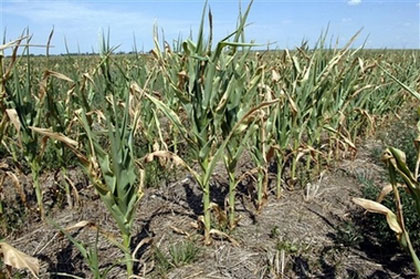
Drought
stricken corn withers in a field in Linton, North Dakota, Wednesday, July
26, 2006. Fields of wheat, durum and barley in the Dakotas this dry summer
will never end up as pasta, bread or beer. What is left of the stifled
crops has been salvaged to feed livestock struggling on pastures where hot
winds blow clouds of dirt from dried-out ponds. [AP
Photo] |
An area stretching from south central North Dakota to central South Dakota is
the most drought-stricken region in the nation, Svoboda said.
"It's the epicenter," he said. "It's just like a wasteland in north central
South Dakota."
Conditions aren't much better a little farther north. Paul Smokov and his
wife, Betty, raise several hundred cattle on their 1,750-acre ranch north of
Steele, a town of about 760 people.
Fields of wheat, durum and barley in the Dakotas this dry summer will never
end up as pasta, bread or beer. What is left of the stifled crops has been
salvaged to feed livestock struggling on pastures where hot winds blow clouds of
dirt from dried-out ponds.
Some ranchers have been forced to sell their entire herds, and others are
either moving their cattle to greener pastures or buying more already-costly
feed. Hundreds of acres of grasslands have been blackened by fires sparked by
lightning or farm equipment.
"These 100-degree days for weeks steady have been burning everything up,"
said Steele Mayor Walter Johnson, who added that he'd prefer 2 feet of snow over
this weather.
Farm ponds and other small bodies of water have dried out from the heat,
leaving the residual alkali dust to be whipped up by the wind. The blowing,
dirt-and-salt mixture is a phenomenon that hasn't been seen in south central
North Dakota since the Dust Bowl of the 1930s, Johnson said.
North Dakota's all-time high temperature was set here in July 1936, at 121.
Smokov, now 81, remembers that time and believes conditions this summer probably
are worse.
"I could see this coming in May," Smokov said of the parched pastures and
wilted crops. "That's the time the good Lord gives us our general rains. But we
never got them this year."
Brad Rippey, a federal Agriculture Department meteorologist in Washington,
said this year's drought is continuing one that started in the late 1990s. "The
1999 to 2006 drought ranks only behind the 1930s and the 1950s. It's the
third-worst drought on record ¡ª period," Rippey said.
Svoboda was reluctant to say how bad the current drought might eventually be.
"We'll have to wait to see how it plays out, but it's definitely bad," he
said. "And the drought seems to not be going anywhere soon."
Herman Schumacher, who owns Herreid Livestock Auction in north central South
Dakota, said his company is handling more sales than ever because of the
drought.
In May, June and July last year, his company sold 3,800 cattle. During the
same months this year, more than 27,000 cattle have been sold, he said.
"I've been in the barn here for 25 years and I can't even compare this year
to any other year," Schumacher said.
He said about 50 ranchers have run cows through his auction this year.
"Some of them just trimmed off their herds, but about a third of them were
complete dispersions, they'll never be back," he said.
"This county is looking rough, these 100-degree days are just killing us,"
said Gwen Payne, a North Dakota State University extension agent in Kidder
County, where Steele is located.
The Agriculture Department says North Dakota last year led the nation in
production of 15 different commodity classes, including spring wheat, durum
wheat, barley, oats, canola, pinto beans, dry edible peas, lentils, flaxseed,
sunflower and honey.
North Dakota State University professor and researcher Larry Leistritz said
it's too early to tell what effect this year's drought will have on commodity
prices. Flour prices already have gone up and may rise more because of the
effect of drought on wheat.
"There will be somewhat higher grain prices, no doubt about it," Leistritz
said. "With livestock, the short-term effect may mean depressed meat prices,
with a larger number of animals being sent to slaughter. But in the longer run
it may prolong the period of relatively high meat prices."
Eventually, more than farmers could suffer.
"Agriculture is not only the biggest industry in the state, it's just about
the only industry," Leistritz said. "Communities live or die with the fortunes
of agriculture."
Susie White, who runs the Lone Steer motel and restaurant in Steele, along
Interstate 94, said even out-of-state travelers notice the drought.
"Even I never paid attention to the crops around here. But I notice them now
because they're not there," she said.
"We're all wondering how we're going to stay alive this winter if the farmers
don't make any money this summer," she said.
