President Bush said Tuesday a new plan to increase U.S. and Iraqi forces in
the besieged capital of Baghdad will help quell rising violence that is
threatening Iraq's transformation to a self-sustaining democracy.
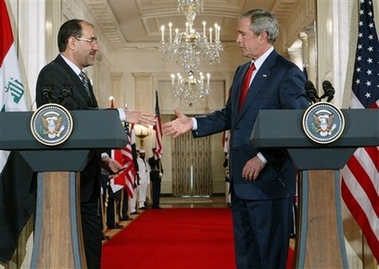
President Bush and
Iraqi Prime Minister Nouri al-Maliki, left, shake hands following the
conclusion of their joint news conference in the East Room of the White
House, Tuesday, July 25, 2006 in Washington. President Bush said Tuesday
that a U.S. military program to bolster Iraqi security forces in Baghdad
will better address the violence there as he pledged to stand by Iraq's
new democratic government. [Reuters] |
"Obviously the violence in Baghdad is still terrible and therefore there
needs to be more troops," Bush said in a White House news conference with
visiting Iraqi Prime Minister Nouri al-Maliki.
Al-Maliki, on his first trip to the United States since becoming prime
minister two months ago, said he and Bush agreed that training and better arming
Iraqi forces as quickly as possible, particularly in the capital city, was
central to efforts to stabilize the country.
"And, God willing, there will be no civil war in Iraq," al-Maliki said,
speaking through a translator.
The two leaders disagreed openly on how to end hostilities between the
Hezbollah militia in southern Lebanon and Israel, with al-Maliki, a Shiite
Muslim leader, reiterating his support for an immediate cease-fire and Bush
sticking by the administration opposition to one.
A group of House Democrats called on GOP leaders to cancel al-Maliki's
address to Congress on Wednesday. Sen. Charles Schumer, D-N.Y., said he doubted
he would attend and that there were a "large number of people (in Congress) who
were uncomfortable" with al-Maliki's condemnation of Israel's attacks in Lebanon
and apparent support for Hezbollah
Bush said that al-Maliki had asked for more military equipment from the
United States and had recommended increasing U.S. and Iraqi forces patrolling
Baghdad neighborhoods. "And we're going to do that," Bush said.
The president said U.S. forces would be moved in from other parts of Iraq. He
did not say how many, but Pentagon officials have suggested several thousands
troops would be moved to Baghdad, including some now based in Kuwait.
There are roughly 127,000 U.S. troops in Iraq. The administration is under
increasing pressure from Democrats and some Republicans to bring a substantial
number home by the end of this year.
Asked if the tense situation in Baghdad would alter the equation for an
eventual withdrawal of U.S. forces, Bush said troop level decisions will still
be based on recommendations from military commanders in the field.
"Conditions change inside a country," Bush said. "Will we be able to deal
with the circumstances on the ground? And the answer is, yes, we will."
The president and the prime minister met privately before the news conference
to discuss strategy, then continued talks over lunch with a larger group that
included Cabinet members and aides.
