President George W. Bush personally blocked a Justice Department
investigation of the anti-terror telephone tapping program that intercepts
Americans' international calls and e-mails, administration officials said.
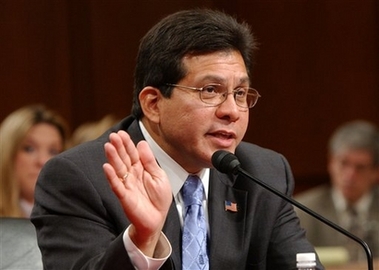
Attorney General
Alberto Gonzales testifies before the Senate Judiciary Committee in
Washington Tuesday, July 18, 2006, during a hearing on Justice Department
oversight. Gonzales said Tuesday that President Bush personally blocked
Justice Department lawyers from pursuing an internal probe of the
warrantless eavesdropping program that monitors Americans' international
calls and e-mails when terrorism is suspected.
[AP] |
Bush refused to grant security clearances for department investigators who
were looking into the role Justice lawyers played in crafting the program, under
which the National Security Agency listens in on telephone calls and reads
e-mail without court approval, Attorney General Alberto Gonzales told the Senate
Judiciary Committee on Tuesday.
Without access to the sensitive program, the department's Office of
Professional Responsibility closed its investigation in April or OPR.
"It was highly classified, very important and many other lawyers had access.
Why not OPR?" Sen. Arlen Specter, the committee chairman, asked Gonzales.
"The president of the United States makes the decision," Gonzales replied.
Later, at the White House, spokesman Tony Snow said the eavesdropping program
is reviewed every 45 days by senior officials, including Gonzales. The president
did not consider the Justice unit that functions as a legal ethics watchdog to
be the "proper venue," Snow said.
"What he was saying is that in the case of a highly classified program, you
need to keep the number of people exposed to it tight for reasons of national
security, and that's what he did," Snow said.
Yet, according to OPR chief Marshall Jarrett, "a large team" of prosecutors
and FBI agents were granted security clearances to pursue an investigation into
leaks of information that resulted in the program's disclosure in December.
Justice Department inspector general Glenn A. Fine and two of his aides were
among other department officials who were granted clearances, Jarrett said in an
April memo explaining the end of his probe. That memo was released by the
Justice Department Tuesday.
The inspector general is conducting a limited, preliminary inquiry into the
FBI's role in and use of information from the NSA surveillance program, deputy
inspector general Paul Martin said.
The existence of the eavesdropping program outraged Democrats, civil
libertarians and even some Republicans who said Bush overstepped his authority.
A group of 13 prominent legal experts wrote lawmakers last week that the
Supreme Court's recent decision striking down military commissions for detainees
at the Guantanamo naval base in Cuba "strongly supports the conclusion that the
president's NSA surveillance program is illegal."
Rep. Maurice Hinchey, who requested the Justice Department investigation,
said he and other lawmakers were preparing a letter to Bush asking him to allow
the probe to go forward. "We can't have a president acting in a dictatorial
fashion," Hinchey said.
Gonzales insisted Tuesday that the president "has the inherent authority
under the Constitution to engage in electronic surveillance without a warrant."
Still last week, under a deal with Specter, Bush agreed conditionally to a
court review of the warrantless eavesdropping operations.
In the House of Representatives, Rep. Heather Wilson introduced a bill
Tuesday to update the 26-year-old Foreign Intelligence Surveillance Act that
would include allowing the government to monitor the suspected terrorists'
communications without a court order for up to 45 days after an attack.
Wilson chairs the Intelligence subcommittee that oversees the NSA and has the
support of Judiciary Committee Chairman James Sensenbrenner, making her bill a
leading proposal in the Republican-controlled House.
Bush's 2001 directive authorized the National Security Agency to monitor _
without court warrants _ the international communications of people on U.S. soil
when terrorism is suspected. The administration initially resisted efforts to
write a new law, contending that no legal changes were needed. But after months
of pressure, officials have grown more open to legislation.
