Former President Alan Garcia, whose 1985-90 government left Peru mired in
guerrilla violence and economic chaos, appeared headed toward victory over
nationalist ex-army officer Ollanta Humala in Sunday's presidential runoff.
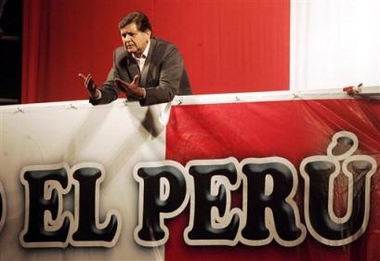
Presidential candidate
Alan Garcia, greets supporters after the presidential elections in Lima,
Peru, on Sunday, June 4, 2006. [AP] |
It would be a stunning comeback for a man whose name had been equated
with political disaster and a rejection of a political upstart enthusiastically
endorsed by Venezuela's anti-U.S. president, Hugo Chavez.
Unofficial partial counts by the polling firm Apoyo and the citizen watchdog
group Transparencia gave the center-leftist Garcia more than 52 percent of the
vote.
The firms each counted the vote at roughly 1,000 polling stations considered
representative of the national vote, and said their counts' margins of error
were less than 1 percentage point.
Appearing before hundreds of followers at his campaign headquarters before
the first official results were announced, Garcia thanked God for what "appears
to be a victory by the party of the people."
He said Peruvians had sent an overwhelming message Sunday to Chavez that they
wanted no part of the "strategy of expansion of a militaristic, retrograde model
that he has tried to impose in South America."
A Humala victory could have tilted Peru into the axis of Chavez, who has
already extended his regional influence, gaining a loyal ally with the December
election of Evo Morales as Bolivia's president. Like Morales, Humala had pledged
to punish a corrupt political establishment and redistribute wealth to his
country's poor Indian and mestizo majority.
But his radical rhetoric frightened many and won Garcia votes on Peru's more
industrialized northern coast and in Lima, the capital, where Garcia said he had
won 65 percent of the vote. Humala appeared headed to victory in Peru's heavily
Indian southern Andes, a stronghold of his support.
The bitterly fought election between the top finishers in an April election
of 20 candidates saw street violence and virulent exchanges of slurs, including
from Chavez, who exacerbated the ill will by vigorously endorsing Humala and
calling Garcia a crook.
At one point, Garcia was hit in the face by an egg, leaving a nasty bruise.
The attack, in the highland city of Cuzco, a stronghold for Humala, was followed
hours later by a shootout involving supporters of the two rivals.
In the final days of campaigning, election observers from the Organization of
American States urged both sides to tone down the rhetoric and avoid violence.
Mario Vargas Llosa, Peru's most famous novelist and a staunch critic of
Garcia, described Humala, 43, as a dangerous autocrat.
"What is at stake in Peru is whether the democracy we have, with all its
imperfections, is going to survive or is going to disappear once again and be
replaced by a military and nationalist dictator, which is what would happen if
Mr. Humala wins," said Vargas Llosa, who made an unsuccessful bid to succeed
Garcia in 1990.
Garcia, 57, adroitly turned the race into a referendum
on Chavez, depicting Humala as an aspiring despot who would fall into lockstep
with the Venezuelan's populist economics and Cuba-friendly anti-Americanism.
