Landmark legislation to secure U.S. borders and offer millions of illegal
immigrants a share of the American dream cleared the Senate on Thursday, a rare
election-year reach across party lines and a triumph for President Bush.
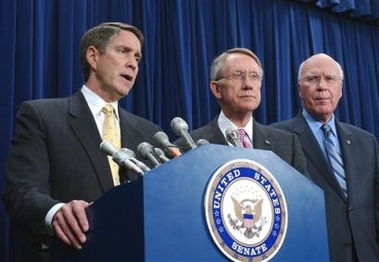
Senate Majority Leader
Bill Frist, R-Tenn., talks with reporters on Capitol Hill Thursday, May
25, 2006, after the Senate voted 62-36 to overhaul the nation's
immigratikon laws. Left to right are Frist, Senate Minority Leader Harry
Reid, D-Nev., and Sen. Patrick Leahy, D-Vt.
[AP] |
The 62-36 vote cleared the way for arduous summertime compromise talks with
the House on its immigration measure focusing on border enforcement with no
guarantee of success. Republicans and Democrats said energetic participation by
Bush would be critical.
"Why not say to those undocumented workers who are working the jobs that the
rest of us refuse, come out from the shadows," said Arizona Republican John
McCain, a key architect of the bill.
The legislation includes money to better secure the borders, provide a new
guest worker program and give an eventual shot at citizenship to many of the
estimated 11 million to 12 million immigrants in the country illegally.
The bill "strengthens our security and reflects our humanity," said Edward M.
Kennedy, D-Mass., McCain's partner in the Senate compromise. "It is intended to
keep out those who would harm us and welcome those who contribute to our
country."
Majority Leader Bill Frist, R-Tenn., and the Democratic leader, Harry Reid of
Nevada, both sided with supporters, a reflection of the bipartisan backing for a
bill that was months in the drafting and survived several near-death
experiences. In all, 38 Democrats, 23 Republicans and one independent voted for
the bill, while 32 Republicans opposed and four Democrats opposed it.
Conservative critics attacked the legislation to the end after trying
unsuccessfully to pull it apart with amendments.
"This bill will not secure our borders," said Sen. Jeff Sessions (news, bio,
voting record), R-Ala., one of the most persistent critics.
"This is amnesty," added David Vitter, R-La., who tried last week to strip
out provisions relating to citizenship.
Not so, said Sen. Arlen Specter (news, bio, voting record), R-Pa., chairman
of the Judiciary Committee, in a rebuttal to weeks of debate. "They have to pay
a fine. They have to undergo a criminal background check. They have to pay back
taxes, they have to learn English and they have to go to the back of the line,"
he said, referring to illegal immigrants who would apply for citizenship.
Still, Sessions, Vitter, John Cornyn of Texas and others echoed a view widely
held among House Republicans, many of whom have vigorously denounced the Senate
bill as well as Bush's call for a "comprehensive approach" to the issue.
That portended difficult compromise talks in the shadow of midterm elections,
at a time when Bush's poll ratings are low, congressional Republicans are
concerned and Democrats are increasingly optimistic about their chances in
November.
Lawmakers in both parties pledged strenuous efforts to reach a compromise.
Specter said that Republicans, as the party in power in Congress and the White
House, had a special burden to produce a compromise. "I believe the president
will put a heavy shoulder to the wheel," he added.
Internal GOP divisions will complicate compromise talks. In the Senate alone,
four members of the leadership voted against the bill, including Sen. Elizabeth
Dole of North Carolina, chairman of the party's senatorial committee.
House Majority Leader John Boehner, R-Ohio, issued a statement that said, "we
owe it to the American people to seek common ground on responsible solutions,
while always stressing our most important priority is to secure our borders and
stop illegal immigration."
The House bill, which passed on a largely party-line vote last year, is
generally limited to border enforcement. It would make all illegal immigrants
subject to felony charges and it contains no provision for either a new
temporary worker program or citizenship for men, women and children in the
country unlawfully.
In contrast, the Senate bill would mark the most far-reaching changes in
immigration law in two decades.
Built on compromise after painstaking compromise, it was designed to appeal
to conservatives and others seeking tougher border enforcement; business
interests eager for a steady supply of legal, low-wage labor; unions seeking
enhanced protections for migrants who often toil in seasonal work the fields and
Hispanics who are on the cusp of greater political power and determined to win a
change in legal status for millions of illegal immigrants.
That last group - Hispanics comprises the fastest growing segment of the
electorate, and millions made their feelings clear in street demonstrations
denouncing the House measure and calling for passage of a broader measure.
Bush played a prominent role in the run-up to passage. An Oval Office speech
last week made explicit his support for the Senate's overall approach. A later
trip to Arizona was designed to reassure conservatives about his commitment to
stanching illegal immigration.
In more than a week of debate, the Senate made a series of changes in the
legislation. Still, the key pillars were preserved when opponents failed to
knock out the guest worker program or the citizenship provisions. A new program
for 1.5 million temporary agricultural workers also survived.
To secure the borders, the measure calls for the hiring of an additional
1,000 new Border Patrol agents this year and 14,000 by 2011, and backs Bush's
plan for a short-term deployment of National Guard troops to states along the
Mexican Border. The bill calls for new surveillance equipment as well as the
construction of 370 miles of triple-layered fencing and 500 miles of vehicle
barriers.
The new guest worker program would admit 200,000 individuals a year. Once
here, they would be permitted for the first time to petition on their own for a
green card that confers legal permanent residency, a provision designed to
reduce the potential for exploitation by employers.
A separate new program, a compromise between growers and unions, envisions
admission of an estimated 1.5 million immigrant farm workers who may also apply
for permanent residency
Even supporters of the bill conceded the three-tiered program related to
illegal immigrants was complicated.
Those in the country unlawfully for five years or more would be permitted to
remain, continue working and eventually apply for citizenship. They would be
required to pay at least $3,250 in fines and fees, settle any back taxes and
learn English.
Illegal immigrants in the country for more than two years but less than five
would be required to travel to a point of entry before re-entering the United
States legally and beginning a lengthy process of seeking citizenship. They
would be subject to the same fines, fees and other requirements as the
longer-term immigrants.
An immigrant in the country illegally for less than two years would be
required to leave with no guarantee of return.
