NASA plans to crash a space probe into the moon in 2009 ¡ª a collision so
violent it will be visible on Earth through a telescope, the space agency said
Monday.
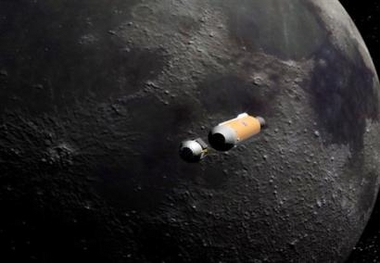
This artist's concept
of an impactor spacecraft, released by NASA, shows the upper stage and a
'shepherding spacecraft' approaching the moon. NASA will send the
spacecraft to the moon with the launch of the Lunar Reconnaissance
Orbiter, scheduled for October 2008. The Lunar Crater Observation and
Sensing Satellite will travel independently of the orbiter and crash into
the lunar surface to search for water ice. [AP] |
The moon crash, part of a larger mission that includes a lunar orbiter, is a
quest for ice. Water is the key ingredient for supporting future human outposts
on the moon, a goal of the Bush administration.
NASA scientists say the collision should excavate a hole about a third the
size of a football field and hurl a plume of debris into space. After the crash
of the space probe, the mothership that released it will fly through the plume
and look for traces of water ice or vapor ¡ª similar to NASA's Deep Impact
mission last July, which blasted into a comet.
The moon collision and orbiter will be the first of several lunar robotic
projects before astronauts are sent to the moon, targeted for 2018. The entire
mission will cost more than $600 million with the impactor project cost-capped
at $80 million.
The mission is set to launch in October 2008, with a rocket that carries both
the Lunar Reconnaissance Orbiter and impactor. The orbiter will circle the moon
for at least a year, mapping the surface, searching for water and scouting for
potential future landing sites to send astronauts. The orbiter will pay
particular attention to the south pole, which NASA considers a prime candidate
for a future outpost.
The lunar spacecraft will target the south pole too, releasing its SUV-sized
impactor probe in January 2009 on a suicide plunge at about 5,600 miles per hour
toward a frozen crater believed to contain hidden ice.
If ice is found, it could be melted and the water used to help make rocket
fuel or oxygen.
"These resources can make (a) future human return to the moon and future
human occupation of the moon much more cost-effective," said Butler Hine,
robotics deputy program manager at NASA's Ames Research Center in northern
California which is developing the impactor.
In the 1990s, several robotic probes found elevated levels of hydrogen, a
component of water, around the moon's poles, suggesting ice might lie beneath
the frozen surface. But they failed to find vast expanses of it.
The 2008 mission won't be the first time NASA has crashed a robotic probe
into the moon. In the 1960s, the space agency launched nine Ranger spacecraft on
such a mission, but only three were successful, beaming back close-up pictures
as they crashed. The 1999 orbiting Lunar Prospector collided into the moon, but
it was considered a disappointment because it failed to kick up a cloud of
debris.