A top Iranian military official said Tuesday the country can now defend
itself against any invasion originating from outside the region ¡ª a clear
reference to the United States ¡ª as it tested a second new radar-avoiding
missile.
The new surface-to-sea missile is equipped with
remote-control and searching systems, state-run television reported. It said the
new missile, called Kowsar after the name of a river in paradise, was a
medium-range weapon that Iran had the capability to mass-produce.
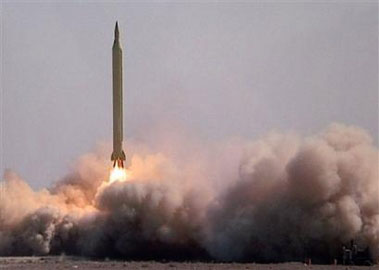
Photo released on Monday April 3, 2006 shows a
test firing of a Fajr-3 missile fired by Iran in the Persian Gulf on April
1, 2006. [AP] |
It also asserted that the Kowsar's guidance system could not be scrambled,
and it had been designed to sink ships.
Shortly after the test, the chief of the elite Revolutionary Guards, Gen.
Yahya Rahim Safavi, warned that Iran was now able to "confront any
extra-regional invasion," referring to the United States without mentioning it
by name.
"The missile command of the Guards' naval force ... via positioning various
types of surface-to-sea missiles, is able, while defending the coastlines and
islands, to confront any extra-territorial invasion," the official Islamic
Republic News Agency quoted Safavi as saying.
Safavi also called for foreign forces to leave the region. The U.S. 5th Fleet
is based in Bahrain, from where it patrols the Gulf.
"Iran wants durable peace in the Persian Gulf and it can't be achieved
without foreign forces and those which invaded Iraq leaving (the region)," IRNA
quoted Safavi as saying.
On Friday, the country tested the Fajr-3, a missile that it said can avoid
radars and hit several targets simultaneously using multiple warheads. Iran also
has tested what it calls two new torpedoes.
The second torpedo, unveiled Monday, was tested in the Straits of Hormuz, the
narrow entrance to the Gulf that is a vital corridor for oil supplies. That
seemed to be a clear warning to the United States that Iran believes it has the
capability to disable oil tankers moving through the Gulf.
The Revolutionary Guards, the elite branch of Iran's military, have been
holding their maneuvers ¡ª code-named the "Great Prophet" ¡ª since Friday, touting
what they call domestically built technological advances in their armed forces.
Analysts have questioned just how radar-evading the missiles are. Iran's
radars are not as advanced as those of Israel, for example ¡ª meaning that
perhaps the new weapons can avoid Iran's radar but not more advanced types.
The United States said Monday ¡ª after the second torpedo test ¡ª that while
Iran may have made "some strides" in its military, it likely is exaggerating its
capabilities.
"We know that the Iranians are always trying to improve their weapons system
by both foreign and indigenous measures," Pentagon spokesman Bryan Whitman said
in Washington. "It's possible that they are increasing their capability and
making strides in radar-absorbing materials and technology."
But "the Iranians have also been known to boast and exaggerate their
statements about greater technical and tactical capabilities," he said.
It has not been possible to verify Iran's claims for the new armaments. But
the country has made clear it aims to send a message of strength to the United
States amid heightened tensions over its nuclear program.
The U.N. Security Council has demanded Iran give up uranium enrichment, a
crucial part of the nuclear process. Washington is pressing for sanctions if
Tehran continues its refusal to do so, though U.S. officials have not ruled out
military action as an eventual option, insisting they will not allow Iran to
gain a nuclear arsenal.
In Russia, a Kremlin-allied lawmaker on Tuesday criticized the recent torpedo
and missile tests as a counterproductive show of might at a time when it should
be trying to allay fears that it is trying to build a nuclear weapon.
"It is clear that Iran is demonstrating its muscle in order to forestall any
discussions of a possible operation using force against Iran," Konstantin
Kosachev, the head of the parliamentary foreign affairs committee, was quoted as
saying according to the RIA Novosti news agency.
On Tuesday, state-run television also said the elite Revolutionary Guards had
tested what it called a "super-modern flying boat" capable of evading radar. TV
showed a brief clip of the boat's launch.
"Due to its advanced design, no radar at sea or in the air can detect it. It
can lift out of the water," the television said. It said the boat was "all
Iranian-made and can launch missiles with precise targeting while moving."
The television showed the boat, looking like an aircraft, taking off from the
sea and flying low over the surface of the water. It said the craft can fly with
a speed of 100 nautical miles per hour.
Iran said the torpedo tests were conducted Sunday and Monday. The torpedo ¡ª
called a "Hoot," or "whale" ¡ª is able to move at 223 mph, too fast for any enemy
ship to elude.
Iran has routinely held war games over the past two decades to improve its
combat readiness and test locally made equipment such as missiles, tanks and
armored personnel carriers.
Iran launched an arms development program during its 1980-88 war with Iraq to
compensate for a U.S. weapons embargo. Since 1992, Iran has produced its own
tanks, armored personnel carriers, missiles and a fighter
plane.