Photo
Saddam's judge is longtime Kurdish lawyer
(AP)
Updated: 2005-10-20 09:35
 |
Large Medium Small |
Silver-haired and patient, the judge presiding over Saddam Hussein's trial is a longtime Kurdish lawyer and judge who has worked under both Saddam's government and under his own people's self-rule.
Rizgar Mohammed Amin, 47, the top judge of a five-judge tribunal overseeing the Saddam case, is from the town of Sulaimaniyah, about 160 miles north of Baghdad. He was asked about a year ago by Kurdish government officials to participate in the Iraqi Special Tribunal, local officials said.
It was unclear if Amin's Kurdish background played any role in his selection as presiding judge. But it is sure to hold symbolic power, because Kurds and Shiite Muslims were the two main groups that Saddam oppressed. The case Amin will oversee concerns Shiite victims of a 1982 massacre.
 This image taken from video shows presiding judge Rizgar Mohammed Amin addressing former Iraqi president Saddam Hussein at his trial in Baghdad's heavily fortified Green Zone in Iraq Wednesday, Oct. 19, 2005. Nearly two years after his capture, Saddam Hussein went on trial Wednesday for alleged crimes against fellow Iraqis, appearing in a tightly secured courtroom accused in a 1982 massacre of nearly 150 Shiites. [AP] |
Amin, wearing a black robe with a white collar, maintained a calm demeanor throughout the three-hour hearing, then adjourned the proceedings until Nov. 28.
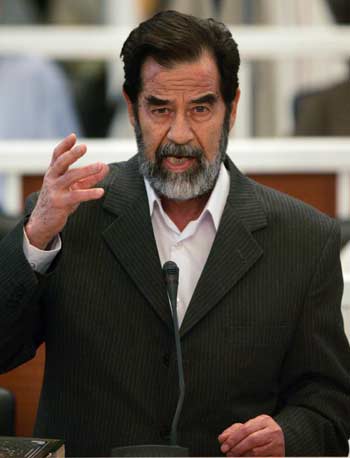 Saddam Hussein defiantly speaks to the Presiding Judge Rizgur Ameen Hana Al-Saedi as his trial begins in a heavily fortified courthouse in Baghdad's Green Zone October 19, 2005. Nearly two years after he was found in hiding, former Iraqi president Saddam Hussein goes on trial Wednesday charged with crimes against humanity for the death of more than 140 Shi'ite Muslim men over two decades ago. [Reuters] |
Amin then tried to get Saddam to identify himself formally, but the former president refused and finally sat. Amin read his name for him, calling him the "former president of Iraq."
Among the many Iraqis glued to their televisions to watch the trial, Amin's manner was the subject of much discussion. Some were impressed, others thought he was letting Saddam get away with too much.
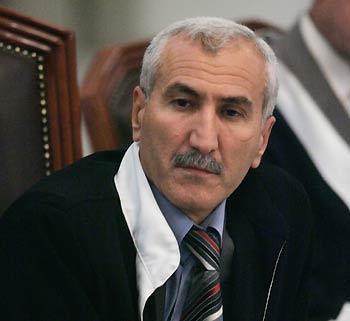 Rizgar Mohammed Amin, 47, the presiding judge of a five-judge tribunal overseeing the Saddam case, conducts the trial held under tight security in Baghdad's heavily fortified Green Zone in Iraq October 19, 2005. Saddam Hussein defiantly challenged the legitimacy of the U.S.-backed court, but then entered a plea of not guilty as he went on trial on Wednesday for crimes against humanity committed two decades ago. [Reuters] |
In the northern city of Kirkuk, Zainab Wali was overjoyed to see a fellow Kurd leading the trial of the ousted president. "I feel like my own brother is judging Saddam since the judge is Kurdish," she said.
But that didn't stop her from screaming at the television when Saddam made his arguments: "Why are you even giving him the chance to talk?"
Amin's name was made known shortly before the trial began.
He is a 1980 graduate of Baghdad University who first worked as a law school teacher in his hometown and then became a judge in the region's courts. He was appointed deputy head of a regional appeals court and then director of Kirkuk's criminal court.
In the first years of his career, he would have thus worked under Saddam's government.
But by 1992, the Kurdish areas in northern Iraq were autonomous, operating outside Saddam's sway.
During Saddam's earlier court hearings, a different judge presided. That judge, Raid Juhi, was the top investigating judge in the case. His role was more like that of a prosecutor in the U.S. federal court system, seeking a grand jury indictment.