 |
|
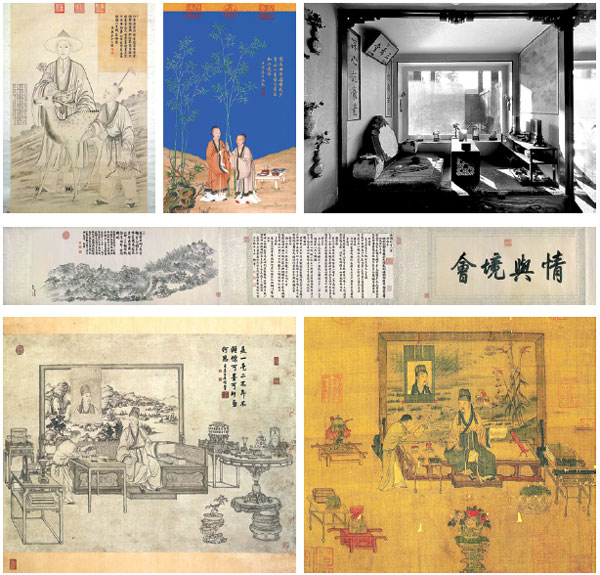
Clockwise from top left: A young Emperor Qianlong (left) wearing Han-style flowing robes; a painting by Italian Jesuit missionary Giuseppe Castiglione featuring Qianlong (left) and a company; Qianlong's study; Eight Sights along the West Lake in Hangzhou by Dong Bangda with accompanying poems written by Qianlong; a Song Dynasty painting; Qianlong appraises antiques by court painter Yao Wenhan, used the same picture-within-picture arrangment, as was used in the Song painting. [Photo provided to China Daily]
|
The current exhibition, at the Zhejiang Museum in Hangzhou, features 202 pieces, with 168 from the Palace Museum and most of the rest from the Zhejiang Museum. On view are various articles from the emperor's own study back in his royal palace, the
Forbidden City (today the Palace Museum). These include a white jade brush rest in the shape of a mountain, an ink bed, a wild duck-shaped water holder and a dark green jade brush pot with vividly carved people in different scenarios, against a backdrop of rockery and pine trees.
It is worth noting that the scenes were meant to depict the private garden of a noted scholar and court official from the Song Dynasty (960-1279), a period that long ago came to represent a pinnacle in Chinese art and literature. Emperor Qianlong, a diligent history learner and passionate art collector, long admired and even sought to emulate the artistic heights reached by Song (and its rulers, best represented by Emperor Huizong, possibly the greatest emperor-artist of all time.).
Qianlong avidly collected Song Dynasty antiques, one such being a pale-green porcelain brush wash, whose demure color and minimalist design went against a riotous, decorative style more commonly associated with the reign of Qianlong.
The piece was from the royal kiln of the Southern Song Dynasty (1127-1279), a period during which a beleaguered Song court moved its capital from Kaifeng in what is now the central province of Henan to Hangzhou, capital of Zhejiang province, and which lies at the heart of Jiangnan. (For those unfamiliar with Song history, the empire spanned two periods: the Northern (960-1127) and the Southern. Constantly defending itself against the harassment of Jins (the ancestors of Manchus) Mongols and others, the empire shrank by one third during the second half of its existence. However, the relocation of the capital to Hangzhou served to further enhance the literary ambience the city was already known for.
Qianlong, whose ancestors constituted a constant source of pain for the Song empire, longed for classical beauty. The aforementioned palegreen brush wash was among his most treasured collectibles. The emperor also used a writing brush made especially for him by master brush-makers in Hangzhou. And this predilection for the life of a literary-minded man influenced other aspects of the emperor's life - and collection, filling it with a sensitivity unusual in a strongman. The exhibition features a red-lacquered wooden box with an iron handle. Two ferocious dragons playing with a fire ball adorn the side of the box; inside it is compartmentalized, with different sections intended for different things: food, tea, and of course papers and brushes. The box, dubbed mountain touring tool, was popular in the Song era, when people with similar tastes and views formed small literary groups, and these groups frequently went on outings, to drink tea, compose poems and be inspired by nature. The box, which invariably appeared on such occasions, was often an object of beauty itself.














 Raymond Zhou:
 Pauline D Loh:
 Hot Pot
 Eco China
 China Dream
 China Face