 |
|
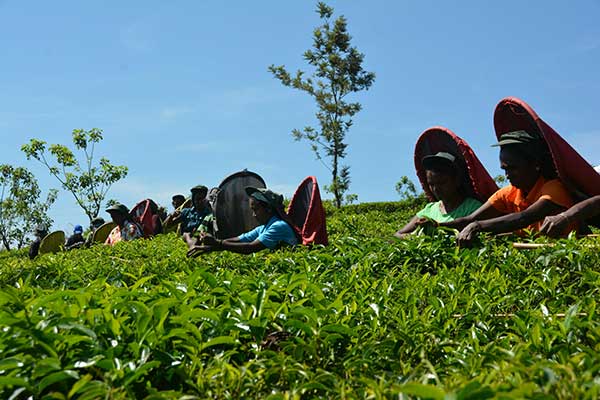
Tea pickers toil in the sun at Kahawatte Plantations in Ratnapura, in Sri Lanka's central highlands. [Photo provided by Vishwamithra Kadurugamuwa] |
International organizations are behind a push to revitalize degraded land in the central highlands of Sri Lanka
Giri Kadurugamuwa climbs onto a mountain slope by the roadside and breaks off a big chunk from the exposed root of a tea tree. Without little apparent effort on his part the chunk falls off like a piece of dried biscuit.
"It's very brittle," says Kadurugamuwa, director of the Alliance for Sustainable Landscapes Management, an NGO dedicated to promoting the sustenance of biodiversity in managed landscapes.
For the past two years the alliance and an international NGO that specializes in ecologically sensitive farming, Rainforest Alliance, have been working on a land protection project in tea growing areas of central Sri Lanka. The work is supported by the United Nations Environment Program with financial backing from the Global Environment Facility, an independent funding body with a global reach.
They work with tea factories and estates, trying to reach smallholder farmers - tea growers with land less than about 4 hectares. Big tea plantations in Sri Lanka can consist of 15 estates or more, each covering hundreds of hectares.
Knowledge is passed by providing training for trainers. Well-trained staff from big plantation companies are expected to teach the smallholder farmers whose produce later feeds the rollers in the factories that the companies own.
Janaka Gunawardene is the manager of a tea factory in Ratnapura, in the central highlands of Sri Lanka. The factory is part of a very big outfit, Kahawatte Plantations, which means it can always obtain leaves from its own vast area. However, the factory also buys a lot from small-growers to keep its own production lines busy. (Because the small growers lack the wherewithal to process leaves, they are forced to sell the raw material to factories.)
"Our company is the very first regional plantation company to get the Rainforest Certificate for sustainable land use since the commencement of the project in early 2015," says Gunawardene. "Although there are other tea estates in the region that have got the certificate since then, ours is the only one that has included the small growers in the project."
A key aim of the training is to reduce the use of chemical pesticides and herbicides, one of the main causes of land degradation, which in turn leads to the brittleness of tree roots.
"A whole set of problems could arise and have already arisen with the overuse of chemicals for the past 30 years," Kadurugamuwa says. "Chemicals, intended for harmful insects and weeds that may overgrow the tea trees or compete with them for nutrients, inevitably kill everything else, from the good insects to birds and small animals that feed on the insects and grasses. As a result, mites have multiplied, as the curled-up tree leaves clearly indicate.
"Meanwhile, losing its grass cover entirely to chemical herbicide, the land becomes exposed. And big rainfall can wash away many nutrients from the soil. Even worse, after a number of years, many bad insects and noxious weeds will have developed tolerance toward the chemicals, leaving farmers with little choice but to adopt even stronger ones."
|
|
|
|
|
|
|
|

Copyright 1995 - . All rights reserved. The content (including but not limited to text, photo, multimedia information, etc) published in this site belongs to China Daily Information Co (CDIC). Without written authorization from CDIC, such content shall not be republished or used in any form. Note: Browsers with 1024*768 or higher resolution are suggested for this site.
License for publishing multimedia online 0108263 Registration Number: 20100000002731 


























 Raymond Zhou:
 Pauline D Loh:
 Hot Pot
 Eco China
 China Dream
 China Face