 |
|
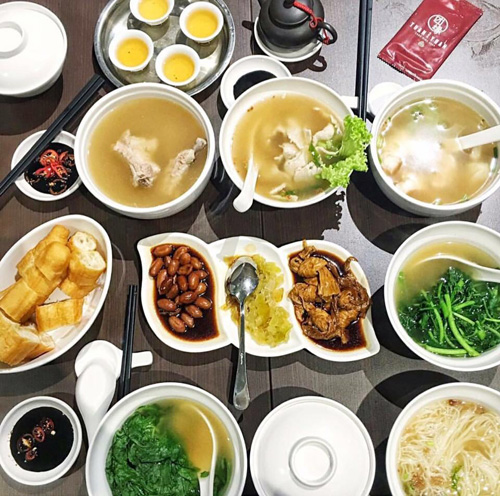
A culinary invention by Chinese immigrants of the 19th century, Pork Ribs Tea has since warmed many hearts. [Photo provided to China Daily] |
However, according to Lim, decadence and luxury were probably far from the minds of early immigrants who had come from other parts of Asia.
"Mostly involved in hard labor, these immigrants developed recipes that used relatively cheap ingredients, which were believed to have an augmenting effect on muscles and bones," he says.
One example is the curry fish head, an early culinary invention by Singapore's Indian community. "Originally, fish heads were considered inedible and were simply discarded. Then someone came up with a recipe - offsetting the smell of fish heads with a cornucopia of spices, for which Indian food is traditionally famous," says Lim.
"And it's not surprising that the Chinese then came up with their own lighter version."
Both versions were improved over the ensuing half century, before appearing in its current incarnation, embedded in Singapore's culinary history.
Like curry fish head, the origin of "pork ribs tea" is probably equally humble, although this has not prevented it from becoming a huge favorite with the Chinese community in Singapore.
"The name of the dish may lead many to think that the pork ribs are boiled in soup with tea leaves, which is not true," says Frankie Gwee, a second-generation immigrant whose parents came to Singapore from the Chinese province of Guangdong during the Japanese invasion in the 1940s. Today, Gwee and his sisters run three Chinese restaurants in Singapore, with pork ribs tea having pride of place on the menu.
"The tea is served separately, during dinner. This is done as the pork ribs soup is a little greasy, and to let diners degrease," says Gwee.
"The early 20th century Chinese immigrants invented the recipe, combining it with the deeply-rooted tea culture they had brought to Singapore from their native Guangdong.
"Most of them were coolies who simply couldn't afford to get ill. Therefore, the peppers and the garlic. While the peppers enhanced the immune system, the garlic was an antiseptic," the restaurateur says, listing the ingredients used in the otherwise slightly bland soup.
According to him, the pork ribs were bathed in soup because for those early immigrants, the top concern was to fill their stomachs.
"For the same reason, ingredients like turnips and starch-rich food including cakes and pancakes appeared on the tables of our forefathers."
Speaking of pancakes, it is impossible not to mention roti jala, a net pancake, although it's more Malaysian than Chinese.
"Fancy-looking, roti jala is unbelievably easy to make," says Lydia Soh, a culinary instructor at Food Playground, a cooking school set up in 2012 to offer tourists and expatriates what Daniel Tan, the school's founder, calls "a cultural immersion experience".
The school is located at 24A Sago Street.
|
|
|
|
|
|
|
|

Copyright 1995 - . All rights reserved. The content (including but not limited to text, photo, multimedia information, etc) published in this site belongs to China Daily Information Co (CDIC). Without written authorization from CDIC, such content shall not be republished or used in any form. Note: Browsers with 1024*768 or higher resolution are suggested for this site.
License for publishing multimedia online 0108263 Registration Number: 20100000002731 

























 Raymond Zhou:
 Pauline D Loh:
 Hot Pot
 Eco China
 China Dream
 China Face