 |
|
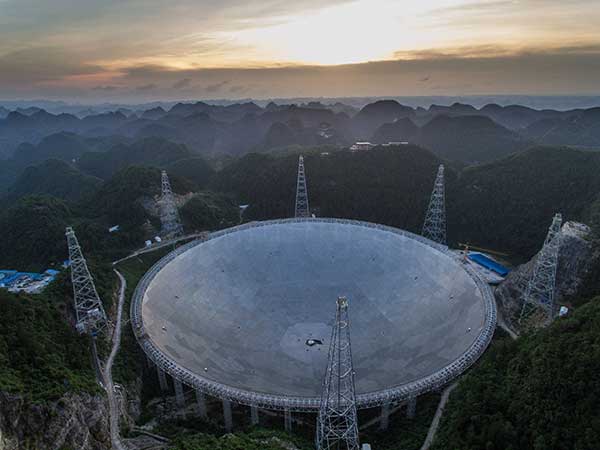
The 500 meter aperture spherical telescope in Pingtang county, Guizhou, to be completed in September, is expected to be the world's largest, overtaking Puerto Rico's Arecibo Observatory, which is 300 meters in diameter.[Photo/Xinhua] |
For more effective observation, astronomers are also striving for breakthroughs in another critical technology: adaptive optics.
When light from a star or any other astronomical object enters the Earth's atmosphere, it can be distorted by atmospheric turbulence, which can blur images produced by any telescope larger than tens of centimeters.
This annoyed Isaac Newton more than 300 years ago when he discovered that larger telescopes could not form clearer images due to atmospheric distortions.
But today, after years of development, many observatories around the world, including those with telescopes of 8 to 10 meters in diameter, are equipped with adaptive optics systems.
Adaptive optics is a technology that aims to correct the distortions induced by atmospheric turbulence. There are three main components in the system: a wavefront sensor, a deformable mirror and a real time controller.
The wavefront sensor is like an eye and it measures the light distortions a few hundreds or even thousands of times in one second, so that the turbulence distortion almost looks like a cartoon played frame by frame to the system; the real-time controller acts like a super fast brain, and it calculates how correction should be applied and sends commands to the deformable mirror; and finally, like the hand of the system, the deformable mirror, carries out those commands, and changes its surface shape to correct the distortions before the next command arrives.
The next generation of ground-based telescopes, including the Thirty-Meter Telescope, the Giant Magellan Telescope and the European Extremely Large Telescope, will have better adaptive optics systems, so they will be central to future observations, says Feng Lu, an associate researcher with the National Astronomical Observatories of China.
Ground-based telescopes can be larger than space telescopes and are connected to more instruments, and can work longer and look deeper into space. The adaptive optics technology will improve their resolution so that is as good as or even better than that of space telescopes, making them capable of observation tasks previously impossible on the ground, such as tracking extra-solar planet candidates, Feng says.
For example, with the help of adaptive optics, the Thirty-Meter Telescope will have a resolving power and sensitivity much greater than the Hubble Space Telescope when it goes into use about the mid-2020s. One of its major tasks will be to analyze the spectrum of extra-solar planets.
|
|
|
|
|
|
|
|

Copyright 1995 - . All rights reserved. The content (including but not limited to text, photo, multimedia information, etc) published in this site belongs to China Daily Information Co (CDIC). Without written authorization from CDIC, such content shall not be republished or used in any form. Note: Browsers with 1024*768 or higher resolution are suggested for this site.
License for publishing multimedia online 0108263 Registration Number: 20100000002731 



























 Raymond Zhou:
 Pauline D Loh:
 Hot Pot
 Eco China
 China Dream
 China Face