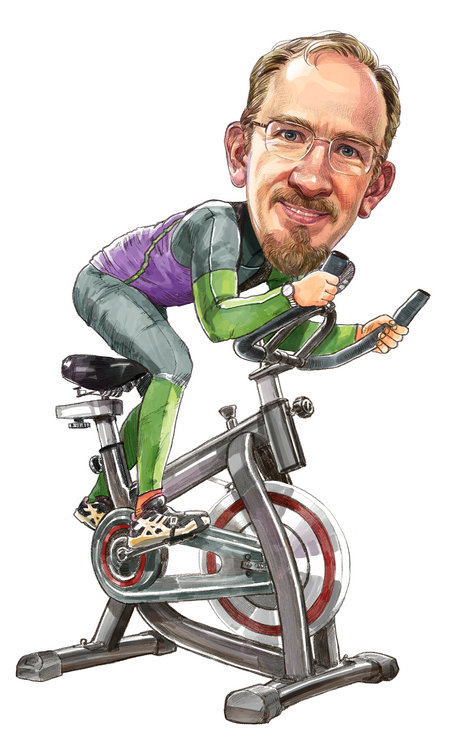
 |
|
[By Cai Meng/China Daily] |
Gyms and I have had a complicated relationship since I was a teenager. In high school, I discovered sports and the joys of weightlifting, and spent several years in a relatively buff state. (But a far, far cry from Arnold Schwarzeneggar, mind you.)
At my best, I could bench press a modest 100-plus kilograms using free weights.
But as I got busy with jobs and kids-and still imbued with that fantasy of twentysomethings of feeling indestructible-I let fitness slide.
I've spent much of the past few decades making sporadic attempts to make the gym habit stick again. Back in the United States, it's relatively easy to find a gym to suit your personality. I tried various gyms, including gung-ho hangouts for jocks, the antiseptic and polite gyms run by hospitals, and bargain gyms for the budget-conscious.
But nothing stuck for very long.
When I moved to Shanghai four years ago, the initial burst of walking long stretches and using stairs helped me slim down. Soon, however, we discovered the city's wonderful food. The weight came back.
In two years, now living in Beijing, I was back to over 100 kilograms. It was time to act. With my wife's help, we radically changed our diet and activity level. Over last summer and fall I dropped more than 20 kg.
But now I felt almost too skinny. What I had not noticed over the years, when I was carrying too much weight, is that I was losing muscle mass. Clearly, I needed to reacquaint myself with a gym.
But where to go? Beijing has an increasing variety of gyms, but not nearly as many as you might expect for a city of its size. As with many popular sports, China is trailing the developed world. But it's catching up fast.
That's especially remarkable given the history of bodybuilding in China. It was first practiced in Guangzhou in the 1930s when Zhao Zhuguang, described as the "original Chinese Charles Atlas", shared what he had learned during a stay in the United States with other university students, according to Susan Brownell's 1995 book Training the Body for China.
But there was a nearly three decade-long hiatus after the sport was banned as "unproductive and narcissistic" in 1953.
Bodybuilding hasn't totally recovered, but it is growing thanks largely to young men looking to trade in a fast-food belly for a Bruce Lee physique.
I took comfort in the Chinese word for gym (jianshenfang, "build body room") being made up of characters that themselves look active. They appear in my eyes like someone doing dips, then a stack of weights, then someone running on a treadmill.
I had tried a nearby gym, where too many of the aerobic exercise machines were in a state of poor repair. Determined to create a new habit, I joined an upscale hotel's gym. It was very nice, so nice that I looked forward to going, but the price was not sustainable, for me, at least.
Armed now with a fledgling habit, I tried a gym, recommended by colleagues, on the top floor of a shopping mall. Like Goldilocks, I found this one was just right. The selection of equipment was good, the hours worked with my work schedule, and the staff and members were friendly. There was even an indoor pool!
Members are a mix, but the core is strong young Chinese men and women who are as dedicated to fitness as any "gym rats" I've seen anywhere. There's a number of nerds still glued to their phones as they pretend to sweat. I'm among the minority of older members, most of us there more for health reasons than vanity. A few appear to be first-generation entrepreneurs who worked hard all their lives, but let their health go until their doctors gave them a stern warning.
There are some foreigners, especially students and a professor or two from nearby universities. The students I've met are from the Middle East, Africa and Slavic countries and the majority seem to speak Mandarin well.
One of the great things about a gym here, or at least the ones I've been to, is that many of the positive attributes of Chinese society also apply at the gym. I've had much younger members do things like move a heavy bench for me without being asked. People are patient and considerate. There is, of course, a little "peacocking" and gratuitous grunting by more musclebound members, but it's not nearly as prevalent as I've seen at some gyms in the States.
Of course, sometimes the phone-gazers sit undisturbed on machines for a long time, as if on their couch at home. While I consider this a serious breach of gym etiquette, it's mostly a mild annoyance.
I do feel lucky that I found a good gym within reasonable bicycling range and within my budget. (I make it a priority.)
Good gyms as a rule aren't cheap. But greater growth in the sector in China could bring down prices, improve quality and spread the considerable benefits, including fighting obesity and all the health consequences that are becoming real problems in an increasingly well-off but sedentary China.
Contact the writer at matthewprichard@chinadaily.com.cn
|
|
|
|
|
|
|
|

Copyright 1995 - . All rights reserved. The content (including but not limited to text, photo, multimedia information, etc) published in this site belongs to China Daily Information Co (CDIC). Without written authorization from CDIC, such content shall not be republished or used in any form. Note: Browsers with 1024*768 or higher resolution are suggested for this site.
License for publishing multimedia online 0108263 Registration Number: 20100000002731 




















 Raymond Zhou:
 Pauline D Loh:
 Hot Pot
 Eco China
 China Dream
 China Face