 |
|
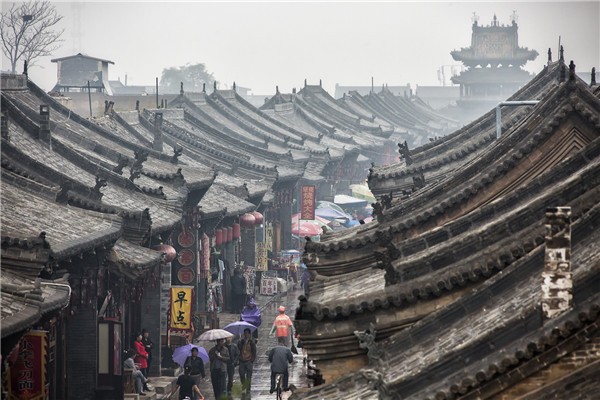
A view of Pingyao. [Photo by Khalid Sharif/For China Daily] |
It sounds like a tough sell, particularly in terms of luring Western visitors from the well beaten track of Beijing, Shanghai, the Great Wall and Yangtze River cruises. As recently as 2001, a well-regarded guidebook to China dedicated barely three of its 700 pages to the province, noting in passing that Linfen was a "small, rather bleak town".
For those interested in the evolution of Chinese history and culture, however, the province is a potential treasure trove. Aside from its established heritage sites, new finds are being made in the fertile loess sediment of the Yellow River plateau in the south that offer fresh insights into the origins of Chinese civilization.
The malleable soil, now leveled into terraced fields, made an excellent environment for building underground dwellings and cliffside caves from prehistoric times onwards. Even today, millions of northern Chinese live in caves, now well-equipped and brick-fronted, that are a familiar feature of southern Shanxi.
Pingyao is one of three Shanxi destinations designated as a World Heritage Site by UNESCO, which describes it as an exceptionally well-preserved example of a traditional Han Chinese city. The grid of narrow streets behind an imposing 3.4 kilometers of walls dates back to the 14th century.
The focus is the ancient government building, containing a court, tax houses and other administrative buildings that reflect a Chinese imperial tradition that lasted into the 20th century. Not just empire, but also commerce - the offices and homes of bankers who set up shop in the 19th century are among the protected wooden buildings. As local guides predictably tell Western visitors, Pingyao was once China's Wall Street.
The charm of Pingyao is that a lively market and the small workshops and homes near the ancient walls give it the feel of a living city. Artisans have revived the skills of Tuiguang lacquer work to produce traditional boxes and screens and functional modern furniture. At one workshop, men were executing the delicate compositions with fine brushes made from human and cow hair. The women were doing the heavy-duty, bare-finger polishing with ground pumice, brick dust and sesame oil.
With tourism in mind, Pingyao has a street of noisy bars, although the staff may have to send out if anyone actually orders a drink. Better perhaps to head for the tranquillity of a traditional courtyard restaurant.
|
|
|
|
|
|
|
|

Copyright 1995 - . All rights reserved. The content (including but not limited to text, photo, multimedia information, etc) published in this site belongs to China Daily Information Co (CDIC). Without written authorization from CDIC, such content shall not be republished or used in any form. Note: Browsers with 1024*768 or higher resolution are suggested for this site.
License for publishing multimedia online 0108263 Registration Number: 20100000002731 


















 Raymond Zhou:
 Pauline D Loh:
 Hot Pot
 Eco China
 China Dream
 China Face