 |
|
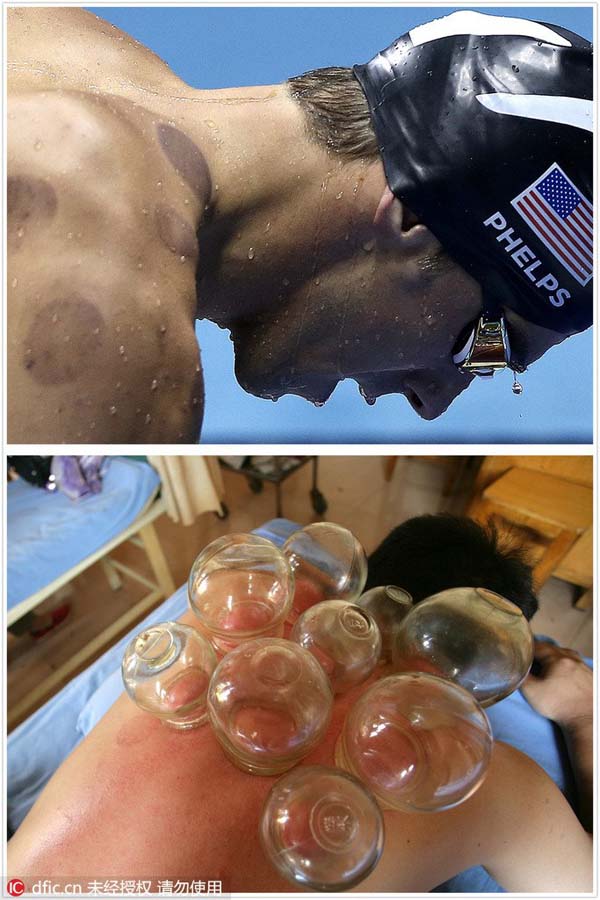
Above: Close-up of Phelps'cupping 'bruises'. Below: A photo shows how cupping is practiced.[Photo/IC] |
As the Olympic games steam ahead in Rio, some unique Chinese specialties have caught the eyes of curious viewers.
"Why do Michael Phelps and other Olympians have big red circles all over their skin?" "Why are so many Olympians covered in large red circles?" Apparently, these circular marks have become a cause of great speculation after several major media outlets highlighted the strange phenomenon.
International netizens have made plenty of guesses: "Michael Phelps probably just fell asleep on all his gold medals," wrote Twitter user @JaredChristopher. Others suggested that the marks might be a"burnt sage ritual," "Phelp's red hickeys" or even "specialized salt glands"that Phelps added to his body. Some social media users guessed at a connection between the red circles and the many safety issues that have been reported on surrounding the 2016 Rio Olympics. @DudeFood.com asked on Twitter, "What's with all the gross spots all over Michael Phelps? Is it from swimming in contaminated Rio water?" Some even suspected that they were the effects of Zika.
Finally, the Associated Press revealed the truth: the circles are the result of cupping, a therapy technique used in traditional Chinese medicine that athletes employ to help their muscles recover. The process involves a practitioner heating small glass cups, then placing them on the skin and finally pulling them from the body to loosen and relax the muscles.
Following Phelps's 19th gold medal win, some excited netizens expressed their happiness by celebrating the apparent success of the cupping. "Phelps and his red dots get gold!" one Twitter user wrote after hearing the news.
As cupping has gained more and more mainstream recognition, many people are wondering if there's a scientific explanation behind this ancient and mysterious therapy. In fact, the medical practice of cupping has a history of over 2,000 years. The process creates a vacuum on the patient's skin, which then mobilizes blood and the flow of Qi to restore physiological balance and support the body's natural healing. The technique is commonly used to treat respiratory illnesses such as the common cold, pneumonia and bronchitis. Cupping therapy occurs in other countries, too, including Japan, South Korea, Vietnam and Singapore. A variation of cupping was also common in ancient Greece.
Like acupuncture, cupping is another well-known example of traditional Chinese medicine that has been embraced by many in the Western world. However, critics of alternative medicine call cupping "pseudoscience nonsense," and state that there is no evidence that cupping works any better than a placebo. Despite the skepticism, cupping is finally having its Olympic moment.
But cupping isn't the only popular Chinese import in Rio right now. Chinese mosquito nets have also become popular with Olympians in Rio.
Ever since Brazil was hit by the Zika virus, many athletes have expressed concern over this year's Olympic venue. Some delegations came equipped with anti-mosquito wrist straps and anti-mosquito sportswear, but it's the bed nets brought by Chinese athletes that have astonished the Olympic village most of all. Foreign media outlets have reported that the bed nets serve as an almost magical anti-mosquito weapon.
Australian basketball player Liz Cambage posted a photo of herself and teammate Tessa Lavey covered with mosquito nets with the caption "ZIKA PROOF AF" on Twitter last week. Chinese gymnast Feng Zhe said on his Weibo account that a foreign athlete came to him looking to buy a "Chinese knot that can protect against mosquitos." On eBay, cunning vendors have started to sell "Rio Olympic-Type Easy Install Foldable Mosquito Net Zika Bed Tents" for $24.50 each, while on Chinese e-commerce platform Taobao, the very same mosquito nets cost only $8.




Copyright 1995 - . All rights reserved. The content (including but not limited to text, photo, multimedia information, etc) published in this site belongs to China Daily Information Co (CDIC). Without written authorization from CDIC, such content shall not be republished or used in any form. Note: Browsers with 1024*768 or higher resolution are suggested for this site.
License for publishing multimedia online 0108263 Registration Number: 130349