Forgotten capital aims to revive past glory
 |
|
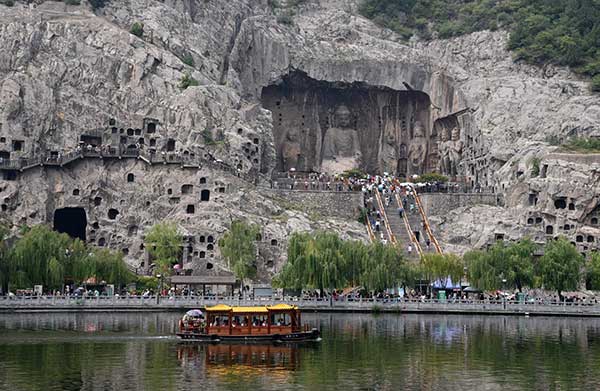
The Longmen Grottoes, a world cultural heritage site in Luoyang in Henan province.[Photo by Hao Qunying/Asianewsphoto] |
The exhibits must be entertaining with impressive visual effects to capture the attention of young visitors, he added.
As one of the "Four Great Ancient Capitals of China," along with Xi'an, Beijing and Nanjing, Luoyang has ambitions to attract more local and international recognition.
The city was at its peak during Tang Dynasty (618-907), when China's only empress, Wu Zetian, moved the capital there from Chang'an, as Xi'an was then known, during her reign (690-705).
Most of Luoyang's ancient architecture has been destroyed by historical wars and the progress of modern construction.
The local government is investing billions trying to restore the grandeur of what is believed to have been world's most populous city during the Tang Dynasty.
The city government has allocated some 47 square kilometers of land in the city center, where cultural relics have been detected underground, for a plan to restore the architecture of the Sui (581-618) and Tang dynasties, said Li Ya, Party secretary of Luoyang.
A national-level cultural relics park, including a lavish reconstructed palace and pagoda built on the ancient foundations, opened to the public in 2015. The imperial garden known as Jiuzhouchi is being recreated in one corner of the park.
Luoyang has a grand plan to restore architecture along the ancient axis line, including ramparts, gates, bridges, and 103 residential complexes where renowned politicians and poets once lived.
"We will build the park step by step as the investment required is huge," said Li, adding that "President Xi Jinping told us to have pride in our culture and people need something tangible to reach consensus on."
The recreated Tang-style architecture acts as a "protective shed" in archeological terms, built above the original foundations to avoid damage to relics.
At the same time the buildings serve as tourist facilities, said Wang Ge, from the municipal cultural heritage bureau.
The park received 850,000 visitors last year and expects to see 1 million this year, according to Wang.