The Grand Canal: a Chinese cultural conduit
 |
|
[Photo/Xinhua] |
The ancient Chinese made two great engineering wonders: the Great Wall and the Grand Canal. Though the Great Wall's function in military defence has faded over time, the Grand Canal remains a crucial conduit of cultural communication.
The Grand Canal, spanning over 2,000 kilometers between Beijing and Hangzhou, was listed as a world heritage site in 2014. Currently, the construction of the Grand Canal cultural belt is a hot topic nationwide.
Why should a man-made waterway be considered such a cultural treasure?
Zhang Shuheng, researcher with the archaeological institute of Zhejiang province, said the canal was a pillar for the economy, social stability and government functions in ancient China.
The canal also worked to nourish the evolution of Chinese culture by enhancing communication between the south and the north.
Hangzhou resident Zhou Zhihua grew up beside the canal.
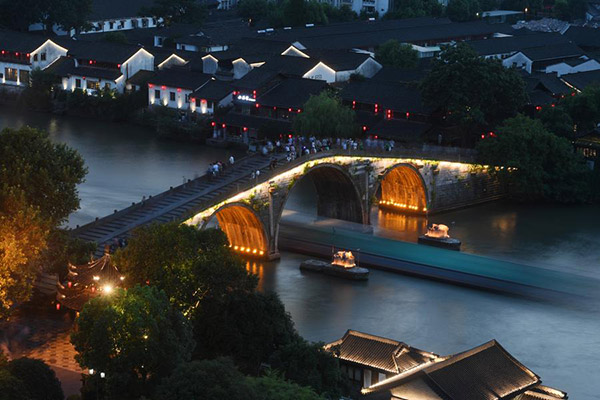
"In ancient times, areas around the Gongchen Bridge was a busy ferry terminal full of people from all walks of life, businessmen, dockmen, rickshaw drivers, vagrants...," he said.
Zhou has been a local folk opera performer for over 50 years. He said that in the early 20th century, opera performers would gather at the bridge to perform, and the boats and tea houses on the dock were ideal stages as well.
Like silk and porcelain, tea was once an important cargo transported on the canal. Tea dealers from different parts of the country gathered at Gongchen Bridge, establishing a business association.
Zhou said the association was also a charity platform that would offer food to vagrants and prepare coffins for those who died in poverty.
"People on the dock, no matter where they come from, whether rich or poor, were all willing to give," Zhou said.
Today, the hustle and bustle of Gongchen Bridge is a scene of the past, but the spirit of openness and philanthropy has become part of the local culture.
At the site of the tea association, Zhou opened a tea house. The tea house has been sending free Laba porridge to local residents during the Laba Festival over the past six years.
Also sitting on the Grand Canal is the city of Suzhou, sometimes called the "Venice of the East" for its abundant waterways.
Andrew Shaw, once a BBC reporter in Britain, found his spiritual home in the Chinese city.