New realities 'rebuild' Beijing's lost city gates
 |
|
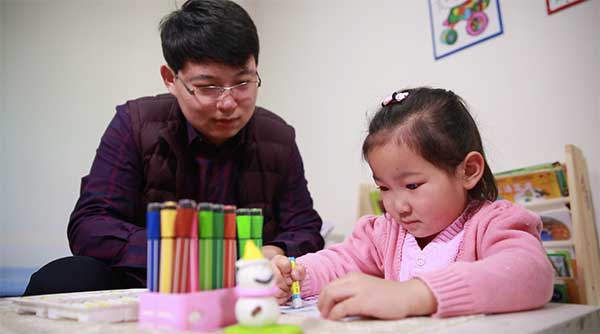
Li Yingchao and his daughter Miduo.[Photo provided to China Daily] |
The Old City
Beijing, China's capital since the 13th Century, once had 20 city gates. They were built as key passageways for different social classes - including the imperial family, civil and military officials, members of the public and even criminals - to come and go from the city.
During the Ming (1368-1644) and Qing (1644-1911) dynasties, Beijing had nine large city gates. They were mostly pulled down in the 1960s, along with the old city wall, to make way for new roads and subways, and to expand the metropolis.
Records show the gates were more complicated than they appeared. A city gate, topped by a two-story tower, usually comprised a gatehouse, an archers' tower and a barbican.
The city planners only left "one and a half" city gates. The "one gate" is Zhengyangmen, on Beiijng's north-south axis at the south end of Tiananmen Square. Built in 1419, it is also known as Qianmen, or "Front Gate".
Bereft of its side walls and barbicans, Qianmen has been restored with a new face. The "half gate" is the Deshengmen archers' tower.
This was news to Li. Born in Shandong province in East China, he arrived in Beijing in 2000 to attend college. Later, he found a job in the capital, married and had a daughter. He knew little about the city's past.
Long working hours meant he seldom played with his daughter. He decided to use the augmented reality technology that he and his colleagues used as a marketing tool for companies such as L'Oreal and Mercedes-Benz to "build" a city gate.
His idea resonated with his team of more than 20 developers. Like Li, they mostly hail from other parts of the country, and with an average age of 28, they had little time to study the history of their adopted home city.
In November, Li and his colleagues invited artists to paint pictures of the nine lost gates, based on written materials they discovered online, then posted them in stations. The group invited subway commuters to scan the pictures to get a visual and aural description of the area they were passing through. The visuals were accompanied by a short commentary on the vanished buildings.
When the project was launched in December, passengers loitered in crowded stations and tried the technology. Some enjoyed taking selfies with the virtual models.
In late January and February, a painting was posted at Chaoyangmen subway station on Line Two.
The project can now be seen at the Beijing Planning Exhibition Hall at an exhibition called Technologies Awaken City Memories.
"It (augmented reality) helps people to learn about the city's history and the changes made," Hu Daxin, the hall's deputy curator, said. "The more you learn, the stronger your sense of belonging."
As Beijing has expanded and its population has risen, the subway's tentacles have stretched further and become more complex. Currently, there are 19 lines, covering 574 kilometers.
The demolition of the city gates and walls to build subways and roads has been a controversial topic for decades.