A river that flows with culture
 |
|
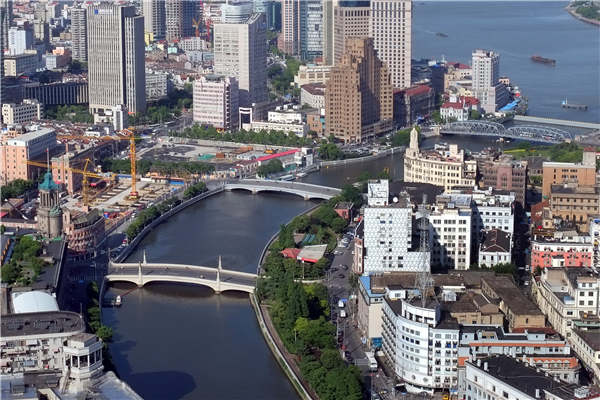
Suzhou Creek, also known as the "mother of Shanghai", serves as an umbilical link to the city's early life-concessions, industrialization and improved living quality. Gao Erqiang / China Daily |
Many world-class cities are endowed with a first-rate river.
Shanghai has two.
Suzhou Creek and the Huangpu River are tributaries of the metropolis' appeal.
Suzhou Creek in particular is worth exploring.
The "mother of Shanghai", as it's also called, serves as an umbilical link to the city's early life - concessions, industrialization and improved living quality.
It snakes 17 kilometers from the Waibaidu Bridge downtown to western Shanghai's outer ring road. The bridge is an icon that appears in many movies set in the city.
Dozens of couples flock to the structure every day for wedding photos.
The "garden bridge", as Waibaidu is also called, marks the point where Suzhou Creek begins and intersects with the Huangpu.
It flashes with colored lights at night.
The 106-meter-long bridge - the first large one built in the city - was designed by a British company and built in 1873.
It no longer serves as a traffic artery - nearly 40 other bridges have been erected over the waterway - but stands as a pedestrian way for tourists.
It's a Shanghai tradition for a grandmother to carry a 1-month-old grandchild across a bridge. It indicates the blessing that the newborn has navigated all the twists and turns so far and will be safe and happy throughout life.
Suzhou Creek's banks hosted the textile mills, chemical plants and factories that propelled Shanghai's 1920s industrialization.
They produced modernization - and pollution. The water was devoid of fish and no longer suitable for taps by the 1930s.
Things started to turn around in the 1990s.
Factories were replaced by sought-after high rises.
Changning district hosts a 5-km waterfront that has become a popular place to walk and sit on lawns. A boardwalk flanks 3 km on either bank.
As 29-year-old resident Xiao Xu puts it: "Jogging on the different sides offers different feelings. The north side is next to the water, while the south side is next to high rises, which makes it like running through the jungle."
Presumably, she means the concrete kind.