A tale of three qiang villages
|
A Qiang woman makes shoes in her courtyard while her husband weaves a bamboo basket in Heihu Qiang village in Aba.[Photo by Li Yang/China Daily] |
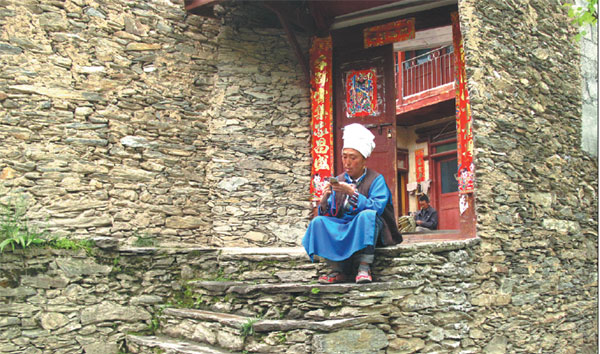
The rocky mountain area in the east of the Aba Tibet and Qiang autonomous prefecture, in West China's Sichuan province, which is located between the Qinghai-Tibet Plateau and the Sichuan Basin, has been a crossroads for trade and civilization for about 3,000 years.
During this period, the interaction between Tibetans, Manchurians, Mongolians, Muslims, the Han and the Qiang people - violent and peaceful at various times - has left us with hundreds of villages of historical interest and picturesque scenery, on high mountains, deep valleys, and along the tributaries of the Yangtze River.
After the Manchurian-dominated Qing Dynasty (1644-1911), Tibetans and the Qiang people became the main residents of the Aba region, roughly as big as Scotland.
The two ethnic groups, now comprising more than 800,000 people, account for about 80 percent of the prefecture's population.
"It is a pity that we have almost lost our mother tongue," says Yu Zhengqing, 74, a Qiang farmer in Dasi, the Qiang village in Aba, who cannot speak the Qiang language.
But he can sing old songs in the language.
Speaking, after a boisterous Qiang dancing and singing performance to greet tourists at the entrance of his village, he adds: "We are also losing Qiangdiao," referring to a kind of ancient tower built exclusively by the Qiang people using rocks, mud and wood.
The Qiang people are known as talented builders who can build sturdy dams, houses and fortifications with natural materials.
Isabella Bird, a 19th-century English explorer, writer and naturalist, who was the first woman to be elected a Fellow of the Royal Geographical Society, used to visit Aba and wrote about Qiangdiao in her book published in 1899 called The Yangtze Valley and Beyond, saying the castle-like towers added liveliness to the endless mountains.
The village used to have 14 Qiangdiao towers, which were built over a period of 500 years.
They were located at carefully chosen spots in and around the 300-home community, to ensure every inch of the vicinity was within an arrow's range and was under the surveillance of the sentries on the towers.
But there is only one tower left today. The rest were demolished during the 1950s or destroyed in the 2008 Wenchuan earthquake.
Speaking of the Qiangdiao, while standing at the foot of the only remaining tower, Peng Zhao, the Party chief of Keku town, to which Dasi village belongs, says: "Few people would build these things today. They are useless in a gun era."
But, Peng and his colleagues pay special attention to protecting the old Qiangdiao in Keku, because "they see it as a symbol of Qiang architecture and, more importantly, a tourist attraction".
Echoing this view, Yang Zhiwen, a successful businessman and village committee director, who returned home in 2006 after having gone to work in Chengdu, the provincial capital of Sichuan, at 16, says: "The loss of Qiang culture is disturbing. "I have seen villagers selling cultural relics unearthed from ancient tombs, and I feel my hometown is being hollowed."
Yang, who says he built a Qiang ethnic culture museum in Dasi as a tourist attraction, now contracts villagers' lands and employs them to plant plum, blueberry and herbs instead of potatoes and corn which they used to grow earlier.
The annual income of the villagers has grown from 500 yuan ($77) in 2008 to 10,000 yuan last year, thanks to tourism and agriculture.
"The villagers now see the value of their unique culture and the advantage of the well-preserved environment on the high mountains," says Yang.
"Also, 10 years after returning to the village, it is now much easier to organize fellow villagers to revive old arts like making clothes, embroidery and doing performances, and to raise their awareness about protecting the Qiangdiao.