The beauty of China’s spring teas
 |
|
Harvesting Sichuan’s Mingqian Queshe green tea in early spring[Photo provided to China Daily] |
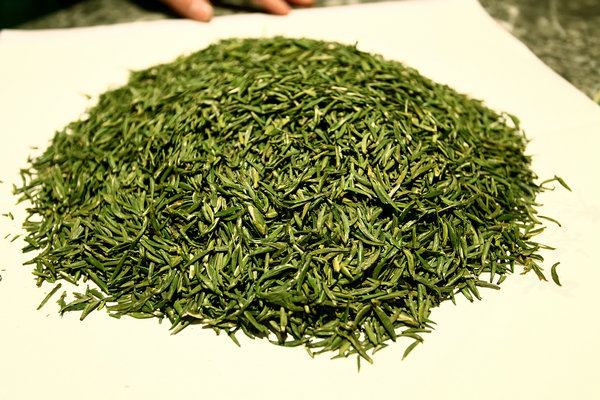
A few minutes after roasting, a delightful aroma filled the kitchen, as if we were in a garden of blooming flowers. After half an hour of continuous roasting, shaking and rubbing of the leaves, the biluochun, adorned with tender white fluff on the tiny center sprouts and a curly leaf, were ready.
The taste and fragrance are so fruity and refreshing that you wonder what chemicals constitute the beautiful sprout and what the tea shrubs have absorbed from the soil to be able to present such a bouquet. The pleasant aroma, and a sweet aftertaste, stay long in the mouth after drinking. It reminds you of the beauty of spring.
A typical biluochun tea leaf has one sprout and one tender leaf. My hostess spends two hours picking spring sprouts in the morning, another two picking out any undesirable leaf. The host then spends half an hour roasting it.
To guarantee quality, tea farmers harvest biluochun only in the spring and early summer for less than a month, commonly from March 20 to April 15. After the harvest, the farmers prune the tea shrubs, leaving them to grow for the rest of the year.
The tea shrubs are grown in between a variety of fruit trees and nut trees, such as loquat, waxberry and chestnut, which might contribute to their fruity flavor.
It is said that 50,000 to 70,000 sprouts are used to produce 500 grams of early spring biluochun, which explains its high prices.
Another famous green tea, longjing, presents a mouthful of orchid and chestnut-like aromas in the mouth after you drink it as well as a sweet aftertaste. The flavor of the green teas usually lasts for three brews.
To brew such tender tea one has to use mineral water, or well water. Tap water is likely going to ruin the subtle taste. The water temperature needs to be lowered to 80 C. If the water is too hot, the taste can become bitter.
Contact the writer at yejun@chinadaily.com.cn
For authentic spring tea, contact Ma Yi at 136-0125-3023