An ancient finance hub shines after its golden era
 |
|
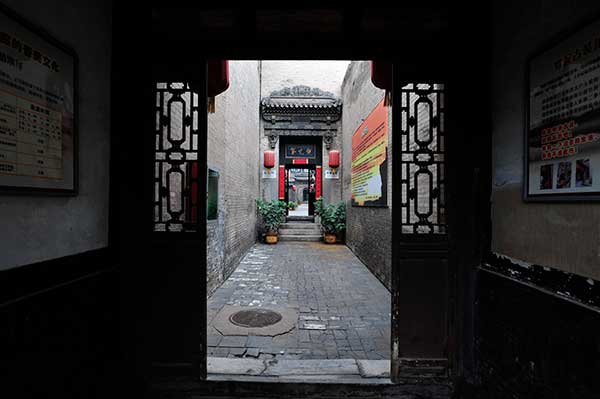
Qixian's well-preserved ancient city tells of its past as a financial hub.[Photo provided to China Daily] |
The town is laced with over 30 narrow lanes-some so constricted, two people have to turn sideways to pass each other.
The tangled lanes' narrowness and configuration is believed to make it impossible for ghosts or evil spirits to prowl. Courtyard gates are also festooned with thousands of stone exorcism tablets.
But the alleyways' arrangement protects residents from not only the supernatural but also such forces of nature as frigid northern winds and sandstorms.
The superstitious may also argue the geomantic layout accounts for Qixian's historical success as a finance center.
Over 500 years, the town and neighboring Yuci, Taigu and Pingyao developed into North China's most prosperous conurbation.
Qixian's affluence peaked from the start of the Ming Dynasty (1368-1644) until the late Qing Dynasty (1644-1911) because China's tea trade with Central and West Asia, and Europe passed through Shanxi before heading through Mongolia.
In the late 19th century, the four counties had a total of around 40 large national banks that did business around the country. Shanghai had only 18.
Around a dozen families ran hundreds of shops in Qixian, where they built grand courtyards and mansions.
Their descendants attribute their ancestors' success to their masterful fusion of Confucian honesty and commerce.
The 20th-century flourishing of China's maritime trade and the Japanese invasion devastated the town's businesses.
But their legacy still stands as more than 1,000 courtyards. About 40 are massive mansions, or former banks, shops or bodyguard agencies.
Some have been converted into museums on the local financial industry, architecture or martial arts practiced by armed escorts.
Two flank houses on either side, plus a two-story building at the end, border courtyards. The compounds are usually arranged three to five in a row and are linked by gates, creating mini mazes inside the large labyrinth that is the town as a whole.
Structures are built with grey bricks, black tiles and wood. Facades are adorned with tile carvings. And images from Chinese legends and religions are embossed on wood, stone and brick.
Houses' rooftops slant to dribble precipitation into the courtyards, as rainfall is considered a symbol of wealth.
Shanxi today trails Shanghai economically-by a lot.
Yet Qixian's residents remain proud of their hometown's past as a business hub.
- Ancient tomb of Northern Zhou Dynasty discovered in Xi'an
- Nanyang's ancient town becomes 'painter village'
- Ancient ancestral worship ceremony held in Xiamen
- Culture: TV drama's focus on ancient etiquette rules pays off
- Ancient town in the echo of Internet
- Ancient Chinese etiquette: Another delight for court drama fans