Martyrs remembered
 |
|
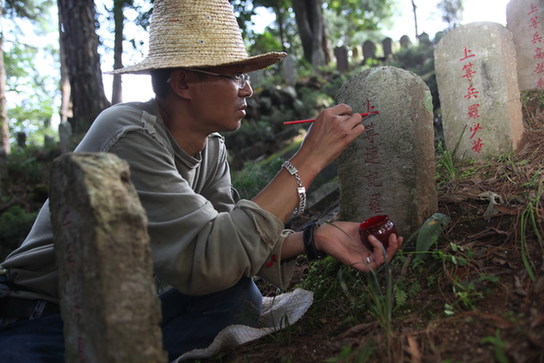
A worker repaints the inscription on a tombstone at the National Martyr Cemetery in Tengchong, Yunnan province. [Photo by Huo Yan/ China Daily] |
The War of Resistance against Japanese Aggression (1937-45) was a dark period in history, and the complex politics of China over the past century means many who fought bravely to expel the invading army were forgotten. Li Yang reports from Yunnan about the special place the National Martyr Cemetery there has in the hearts of the local people.
The National Martyr Cemetery has a special meaning to the half a million people living in Tengchong, a county bordering Myanmar in Southwest China's Yunnan province that was the first county in China liberated from occupation by the Japanese army in World War II.
|
 |
|
|
Across the street from the cemetery is the Confucius Temple, which was used by the Japanese army as a place to rape "comfort women" from May 1942 to September 1944.
By taking Tengchong, the Japanese army cut the road connecting Myanmar and China, an important channel for the United States to send supplies to the Chinese army.
The 20th Group Army of the Expedition Army of the Kuomintang took the county back in Sept 14, 1944, after a bloody 127-day battle, killing about 6,000 Japanese troops and losing 9,168 Chinese soldiers and 19 US soldiers.
The cemetery, covering an area of 53,300 square meters, was built in July 7, 1945, with donations from local people, most of whom were descendants of soldiers who came to defend the border from Jiangsu and Gansu provinces in the Ming Dynasty (1368-1644).
All the bodies of the Chinese soldiers were incinerated together and their ashes were put into 3,346 porcelain altars and buried on a 30-meter-high hill in the center of the cemetery. A tombstone carrying a martyr's name and his military rank was erected on each grave.
On the top of the hill, a monument was erected, made of local igneous rock and inscribed with the calligraphy of Huo Kuizhang, the commander-in-chief of the 20th Group Army of Kuomintang. It reads: "Martyrs liberating Tengchong never die."
Pine trees, cypresses and bamboos are planted throughout the cemetery, giving the graveyard lots of shady areas.
In the middle of the hill are the cenotaphs of 19 US soldiers and three wooden buildings of memorial and exhibition halls, around which stand a group of stone tablets inscribed with eulogies by Kuomintang generals and officials of the martyrs and local residents, and their accusations of the Japanese army's actions in Tengchong.
Statues of Chinese soldiers, US army commanders Joseph Stilwell and Claire Lee Chennault, and the brave county head Zhang Wende, who refused to surrender to Japanese, dot the large stretch of grassland at the foot of the hill.
A small tomb named "Japanese invaders' grave" covered with wild grass is at the border of the grassland facing the martyr's hill and statues. Four Japanese soldiers' bodies were buried in the tomb in a kneeling position, as if to offer an apology to the Chinese and US soldiers.