A world of their own
If Hakka are permanent guests from North China, Meizhou in eastern Guangdong province is the perfect locale to showcase their hospitality, writes Raymond Zhou.
|
|
|
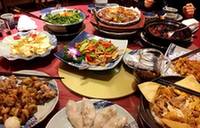
Home-style cuisine packs a punch in warmth of family gathering |
|
|

The Hakka people are so intensely proud of their heritage that you'd be forgiven if you mistook them for a separate ethnicity. But they are just as Han as anyone else of the majority race in China, perhaps more so than people who live in northern China, where the ethnicity hailed from. Customs and speech patterns evolved separately from the mainstream, and these inhabitants of southern China have stubbornly maintained them as a lifestyle and as an identity.
Currently 70 million strong in number, the Hakka first relocated to the south more than 2,000 years ago as part of Emperor Qin's 1 million-plus troops. Wars and social disturbances in later years sent more migrants down south into the mountainous provinces of what are now Guangdong, Fujian, Jiangxi and Guangxi.
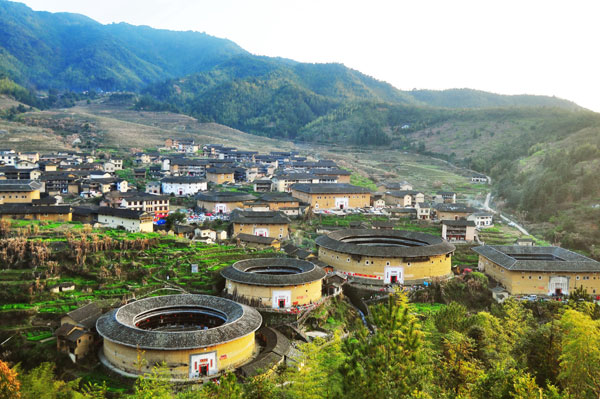
The most visible evidence of the Hakka way of living is its architecture. Called weiwu (self-encircling house) in Meizhou and tulou (mud building) in Fujian, it is a mammoth compound that housed an entire clan, often with hundreds of residents. While tulou is usually round in shape, weiwu can be square or rectangular or curved on one side. The size of a weiwu is identified by the number of encirclements. For example, I was told there are weiwu with as many as five compounds, one within another.
I had the good fortune to visit Pan'anwei, about an hour from downtown Meizhou, which is the center of Hakka culture. By no means the largest of its kind, it is however the best preserved because inhabitants did not build their separate new houses on the premises or very close to it, as others have done, but moved a respectable distance away, leaving the old architecture, built in 1895, as it was.
There are now only a dozen people living in it, all senior citizens whose sense of responsibility to protect the property handed down from their ancestors is stronger than that of the young generation. That means most of the 122 rooms are lying vacant. Some seem to have been left deserted for decades.
There are three circles of buildings, with only the middle one in a crescent shape. The outermost has four corners that are reinforced like a fortress, complete with embrasures. You can imagine how hard it would have been for those who lived inside to be attacked by bandits. In that sense, the weiwu was not just an abode but a refuge from danger.