A trip through time
 |
|
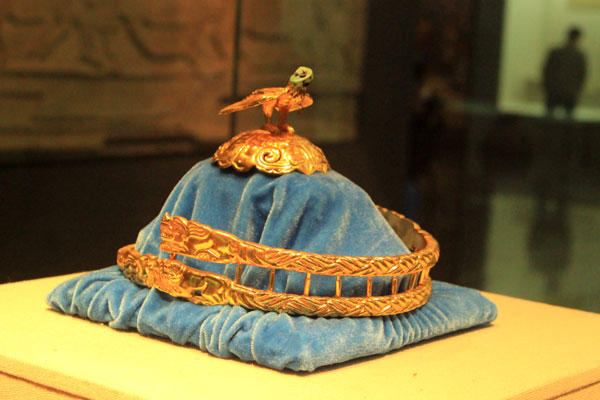
The golden crown of a Xiongnu chanyu (nomadic leader),made during the Warring States Period (475-221 BC),is one of the key exhibits in the museum.[Photo by Wang Kaihao / China Daily] |
I try to recall details from my history textbooks about the conflicts and bonds between Xiongnu and southern dynasties over hundreds of years.
I am fortunate to already have some fundamental knowledge of the region after staying in Inner Mongolia for one year.
A hall on the second floor presents the history of other non-Han ethnic groups of Inner Mongolia, especially those living in the far northeast deep in the Greater Hinggan Mountains who still maintain their traditional lifes-tyles, including the Ewenki people who are China's last reindeer raising tribe and practice shamanism. Having once been intoxicated by their mysterious customs, I feel transported there once again as I stare at the pictures and exhibits of daily items and vivid waxworks depicting their lives.
The third floor has several halls focusing on certain themes, including Mongolian paintings, costumes, and Buddhist sculptures, as Tibetan Buddhism became the dominant religion among Mongols in the late 16th century. There is even an interesting section introducing different kinds of saddles. I once had an unpleasant horse-riding experience caused by my poor skills - perhaps, I should have come here earlier to learn more.
The biggest difference between the Inner Mongolia Museum and the National Museum of China in Beijing, is that in Inner Mongolia there are many more displays beyond historic relics and those on traditional culture. This is why the guide tells me to leave the first floor until the end. It is more like a popular science gallery. As a major mining hub, a region with a highly diversified landscape, and home of the country's only spaceport that sends humans into space, Inner Mongolia has many natural at tractions.
Of course, the finale of my afternoon tour is breathtakingly marvelous: In a 3,000-square-meter hall, the larges tin the museum, are gathered various fossils discovered in Inner Mongolia in recent decades. No one can forget the 26-meter-high skeleton of Nurosaurus. Unearthed in 1985 in Chagan Nur, a lake in Inner Mongolia's northern Xilin Gol region, it remains the biggest dinosaur fossil from the Cretaceous period (about 145.5 million years ago to 65.5 million years ago)ever found in Asia.
After walking for so long and absorbing so much knowledge, it's advisable to rest both mind and body.