Anhui architecture shows glamor of history
 |
|
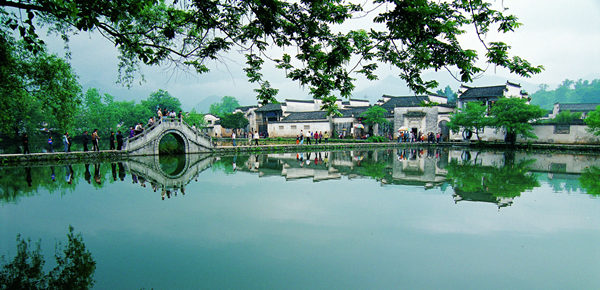
Nanhu Lake in Hongcun village at the foot of Mount Huangshan. Photo provided to China Daily |
|
|
|
|
Seen from above, the village resembles an ox with a nearby hill as its head and two trees as its horns. Buildings in the village form its body while four bridges that span Jiyin stream constitute its legs. The opening scene from Oscar-winning director Ang Lee's Crouching Tiger, Hidden Dragon was partially filmed on one of the bridges.
Hongcun once housed 150 families and ranked as one of the most affluent villages in ancient China. Nearly all of the men were Hui (old name for the region) merchants, part of a group of businessmen who dominated trading in the country for hundreds of years. They spent a fair amount of their fortune from trading salt and tea on decorating their homes.
Rich Hui merchants and officials liked to put intricate brick, wood and stone carvings on the walls of their houses. Some of the carvings date back to the beginning of the Song Dynasty (960-1279), and their patterns include figurines, birds, flowers, landscapes and even images from fairy tales. Most of the buildings in Hongcun have an opening on the roof to let in sunlight and provide ventilation.
There are many villages like this in the area, but Hongcun is so well preserved because local residents covered the carvings with mud during the "cultural revolution" (1966-76) so they were not detected and destroyed.
Although scores of families still live in Hongcun - some because they don't want to let go of their old way of life, others to cash in on the daily visits by tourists. The men are usually absent on business, and my guide told me that the wives would get so lonely they used to spill chess pieces on the ground at night and pick them up just to kill time.
The admission fee for Hongcun is 104 yuan ($17). A taxi from Huangshan Railway Station to Tunxi Bus Station costs 10 yuan (about 4.4 km). From there, look for any bus with the Chinese characters of Hongcun written on the front. The bus ride to Hongcun (85 km) costs 17.5 yuan.