Law to curb tourism price hikes
 |
|
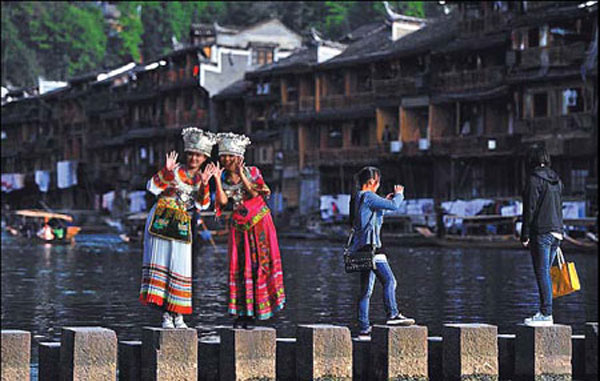
Tourists pose for photos in ethnic clothes in the scenic old town of Fenghuang, Hunan province. The town recently began to charge tourists an entrance fee, which sparked a huge debate and a protest from local vendors. [Photo/Xinhua] |
The third draft of China's Tourism Law, which was delivered to lawmakers on Tuesday, seeks to curb price inflation at scenic spots - a trend that is making tourists nationwide unhappy.
The draft proposes strict controls on the costs of tickets to access natural scenery and ancient relics.
Such areas, the draft said, should hold hearings before raising prices to solicit opinions from tourists and business owners on whether the charges are necessary and reasonable.
The draft law, which was discussed in August and December last year, is the country's first legislation covering the industry.
Li Fei, deputy director of the Law Committee of the National People's Congress, the top legislature, said the latest draft sets rigid procedures for raising prices as many members of the NPC Standing Committee said price appreciation has been "arbitrary".
The proposal was delivered after a high-profile price-raising dispute in Fenghuang, Hunan province, this month. The old town, known for its well-preserved architecture dating back to its founding more than 300 years ago, has started to collect an entry fee of 148 yuan ($24) from travelers. Entry used to be free.
The city government, which argued that the move was necessary to limit swarming tourists and to protect architecture, held no hearings before raising the price.
Apart from the recent price dispute affected by the price adjustments in Fenghuang, many other tourism sites increased the prices of their entry fees. Emei Mountain, the well-known scenic area in Sichuan province, raised its entry fee for peak season from 150 yuan to 185 yuan, and from 90 yuan to 110 yuan for the off-season.
"It's normal that the scenic areas increase the price of entry fees regularly with inflation," said Wu Hao, who works in the ticket office in the Mount Emei tourist spot.
Wu added that the attraction site also would launch certain special reductions on entry fees annually during the off-season to attract tourists.
As a 2007 notice released by the National Development and Reform Commission, the price of entrance tickets in scenic areas are not allowed to be changed for three years. Some tourist attractions raised the prices in March, which is the start of the second three-year cycle.
Xie Xu, a manager with online travel company Ctrip in charge of more than 400 tourist scenic spots in Zhejiang province, said the increase in ticket prices is reflected mainly in those national 4A-level scenic spots rather than the top 5A-level attractions.
"I wouldn't say the price goes up a lot. It's somewhere around 10 percent," said Xie, adding that most tourist destinations set separate prices for their peak season and offseason.
Ticket revenue for China's 153 national top-level scenic spots and more than 2,000 4A-level ones generated more than 40 percent of China's 140 billion yuan in ticket sales in 2012, according to Yang Yanfeng, associate researcher with China Tourism Academy.
Ctrip said that 3.1 billion scenic-spot entrance tickets were sold in China last year, up from only 2.6 billion in 2011.
"Scenic resources provide local governments' incomes, so it's hard to stop the increase of ticket price by controlling local governments, even through legislation," Yang said.
Zhou Lingqiang, a professor of tourism management at Zhejiang University, said the price increases are a method that authorities use to protect scenic areas.
"The local government probably is trying to protect the scenic area from overcrowding by increasing the price of the entry ticket, which will turn out to be effective as a long-term strategy," said Zhou.
Zhou added that controlling the number of daily visitors to the attractions probably would be a better way to protect those cultural heritages than increasing entry fees would.
|
|
|