Fusion of faiths
 |
|
[Photo/CFP] |
An off-beat church aims to find common thread in world religions. Erik Nilsson reports in Tay Ninh, Vietnam.
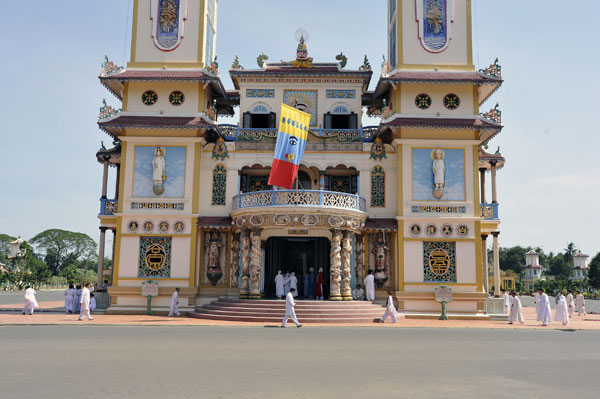
Sun Yat-sen, Laozi and Buddha are venerated by most Chinese but worshiped by Vietnamese Cao Daists — along with Jesus, Mohammad, Pericles, Joan of Arc, Louis Pasteur, Vladimir Lenin, William Shakespeare and Victor Hugo. That’s not to mention practitioners’ ancestors. Cao Dai’s fusion of faiths is manifested most prominently in its Great Temple, which is frequented by not only devout followers but also by inquisitive visitors. This building’s structure, like that of the religion it houses, is also an assortment of symbolism from various creeds.
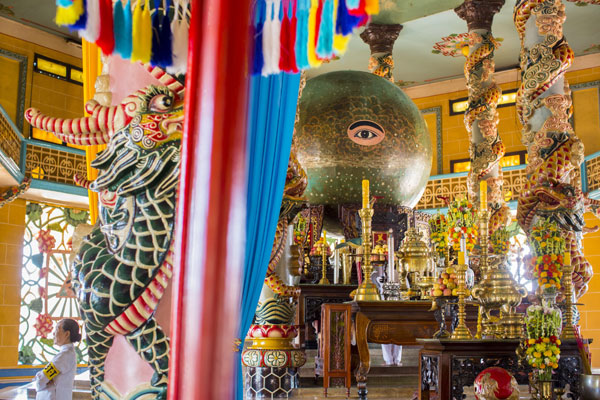
Seven-headed cobras personify the seven human emotions. The 28 dragon-coiled columns embody Buddha’s 28 forms. The main dome’s nine sections — spangled with stars — represent the nine parts of heaven.
But the icon that gives the greatest insight into Cao Dai’s theology is the all-seeing left eye symbolizing both God and the heart.
The reason it’s not the right eye can be seen in its pupil — a yin-yang symbol. In Cao Dai’s assessment, God is yang, and yang is leftward.
The concept of yin and yang comes from Taoism, as does the name Cao Dai, which translates as “High Tower”.
That’s largely because its founder, Ngo Van Chieu, was Taoist until a table-juddering seance purportedly led him to embrace all gods as different manifestations of the human understanding of a supreme being.
The temple’s color scheme also adheres to the theology’s interfaith affinity. Yellow represents Buddhism, blue nods to Taoism and red signifies Christianity.
 |
|
[Photo/CFP] |
Cao Dai is an amalgam of Confucian morality, Taoist ritualism, Buddhist karma and reincarnation, and Roman Catholic hierarchy, and it even has its own pope. It also borrows components from other world faiths as well as the Vietnamese Giniists.
While it recognizes all major religions’ deities, it considers them one god understood in different ways, ultimately making it monotheistic.
As the religion’s official website puts it: “The noble effort of Cao Dai is to unite all of humanity through a common vision of the Supreme Being, whatever our minor differences, in order to promote peace and understanding throughout the world.
“Cao Dai does not seek to create a grey world, where all religions are exactly the same, only to create a more tolerant world, where all can see each other as sisters and brothers from a common divine source, reaching out to a common divine destiny realizing peace within and without.”
Cao Dai’s relatively young age might explain its post-modern theology. It was formally founded in 1926, and the Great Temple — one of about 1,000 in southern Vietnam — was constructed in Tay Ninh city from 1933 to 1955.
Visitors can watch services in the 5,200-square-meter temple from the balcony as long as they’re quiet, shed their shoes and don trousers. Worship is staged every six hours, starting at midnight.
|
|
|