Memorial swirls with the forces of China's history
 |
|
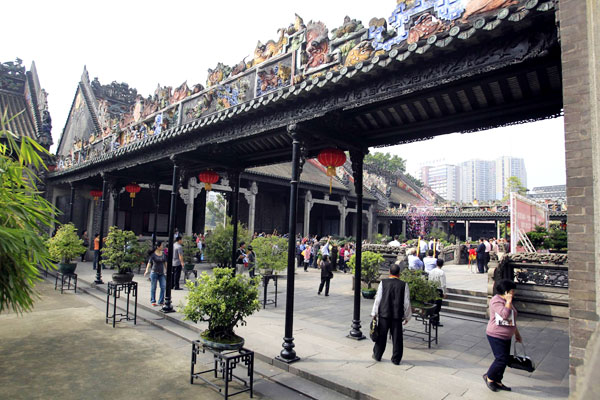
The Chen Family Temple is a historical gem hidden in the concrete jungle of skyscrapers in the heart of Guangzhou. Zou Zhongpin / China Daily |
It is somewhat difficult to define the Chen Family Temple. It has been called a school or a clan temple, and at various times it had housed a museum and a printing shop.
Now, it stands in the western part of Guangzhou as the biggest compound of historical architecture.
Some of the 19 halls serve as galleries for a wide range of local arts and crafts, from Cantonese embroidery to pottery and porcelain, and even to Cantonese Opera.
When it was completed in 1894 (it took seven years to build), it was meant to be a clan temple for Guangdong's most common surname.
Chen, or Chan in Cantonese dialect, is among the top five surnames in the whole country, but was believed to be the most prolific in the province. However, such a common surname covers families that may not have been related even traced back 1,000 years. So, it was not at all like a regular clan temple that served a village.
The government of the Qing Dynasty (1644-1911) interpreted this kind of clan temples as a new political force that existed outside its control and might threaten its existence because it acted as an independent court of law and could easily organize an opposition.
|
|
In face of sporadic crackdowns from the government, the Chen Family Temple, like many similar but much smaller ones of the era, eschewed the name of clan temple and adopted the moniker of a school.
The closest function it had in education was to accommodate students of Chen families who visited the provincial capital city to prepare for the imperial examinations, which, paradoxically, was abolished in 1905.
As an all-inclusive clan temple, the initiators sought assistance from prominent figures, whose family name was Chen, and then raised funds for the purchase of land and the buildup of the massive structure by selling the rights to erecting shrine plaques for ancestors.
More than 10,000 across the province participated. Every spring and autumn, a ritual was held in memory of these Chen ancestors.
The 6,400-square-meter compound (twice as big if you include the open space outside) did not transform into a formal institution of education until the 1,000-year-old imperial exam system was gone.