Longtang
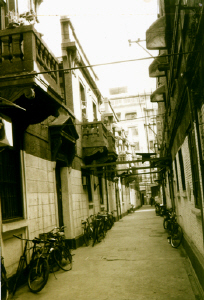
The rank differences of longtang could also be reflected in their life-style and culture. "If you enter a longtang, you will find urinals, snack stalls, flies flying in hordes, children fighting in groups, fierce turbulences and sharp curses. What a disorderly small world!" This was what Lu Xun wrote in his essay, "Children in Shanghai" to depict a longtang of the lowest class. Residents of such a longtang , in order to lessen the burden of rent or to earn some extra money, would lot out their surplus rooms to others and became an "er fang dong" (literary a second landlord-a subleaser). Some even divided their houses into many small rooms, or built attics above and had rented them to people who came to Shanghai to make a living or to take refuge. Thus the longtang became very crowded, with bad living conditions and frequent disputes. A satirical play entitled "72 Tenants" gave a vivid description of this sort of longtong. In longtangs of the middle and middle-lower classes, there were also some "er fang dong" and "san fang ke" (those who rented their rooms from the subleaser), but the "fang dong" here would choose their tenants. It is interesting to note that many progressive literary men from interior China at that time lived in the "tingzijian", a small back room in a longtang house, which is cold in the winter and hot in the summer.
This evolved the so called "Tingzijian Literature" in the history of modern literature of China. "Tingzijian Literature" is not something that depicted tingzijian, but a term referring to a category of progressive literature written by some young writers who could only afford to live and work in the tough condition of a tingzijian, but that viewed the world with a new and realistic view. People nowadays, when criticizing the indifference of human relationship, like to talk about the good neighborly relationships of past longtangs as a universal model. But, in fact it was only partially true, for it seemed that the higher the class of the longtang, the colder the relationships among residents. In those high-class 1ongtangs, only a few children could be found playing around, and even fewer people passing by. Occasionally, two or three maid servants or cooks could be seen chatting in low voices by one side, or the gate of a house seen opening while a host bids farewell to his guests. Those who were passing by might cast a glance but tried not to pay attention.