Shaolin Temple
 |
|
Shaolin Temple is the birthplace of Buddhism's Chan Sect (Zen) in China as well as the cradle of China's Shaolin Wushu (martial arts). |
Shaolin Temple is located at Dengfeng county, Zhengzhou city of Henan province. It is the birthplace of Buddhism's Chan Sect (Zen) in China as well as the cradle of China's Shaolin Wushu (martial arts). In 1983, it was designated as one of national key temples in the areas of the Han nationality.
Shaolin Temple was founded in the 20th year (496) of the Taihe reign of the Northern Wei Dynasty (386-534). It was named Shaolin Temple because it is situated in the heart of Songshan Mountain, the middle one of Five Famous Mountains in China, and within dense woods at the foot of Shaoshi Mountain.
It is said that this temple was built by Yuanhong (Emperor Xiaowen of the Northern Wei Dynasty) for the purpose of accommodating Buddha, an Indian monk who came to China to disseminate Buddhist doctrines. Afterwards, Bodhidhama, the founder of the Chan Sect in China, came to Songshan Mountain via Guangzhou city and Nanjing city by sea. In Shaolin Temple, he widely recruited disciples, and carried forward Buddhist doctrines. Since then, the status of Shaolin Temple as the Chan Sect's birthplace has been established.
Shaolin Temple is also famous for its Shaolin Kongfu. Shaolin Kongfu obtained its great reputation during the Sui and Tang dynasties (581-907). In the Song Dynasty (960-1279), it became a unique school of Wushu named Shaolin School in the history and began to become an outstanding one among China's Kongfu schools. During the Yuan Dynasty (1271-1368), Shaolin Temple has more than two thousand monks and became a prestigious Buddhist temple. After the mid Qing Dynasty (1644-1911), it gradually declined.
Shaolin Temple covers an area of more than 30,000 square meters, so its scale is great. Much attention has been paid to symmetry of its overall arrangement. On its medial axis stand the Gate of the Temple, Heavenly King Hall, Main Hall, Sutra Hall, Abbot's Room, Thousand Buddhas Hall, etc., and a number of important buildings stand on both sides hereof.
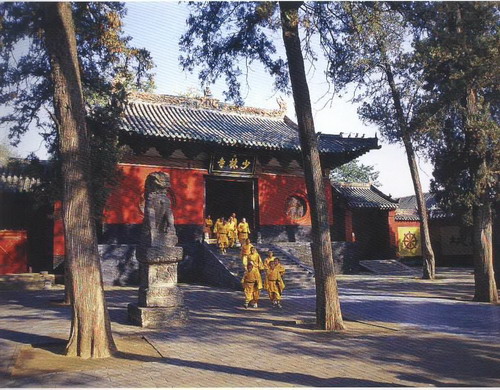
The Gate of the Temple is in the shape of red wall and green tile, and three characters Shao Lin Si (Shaolin Temple) on the tablet of the Gate were written by Emperor Kangxi of the Qing Dynasty. The Statue of Sakyamuni and the Statue of Kwan-yin are enshrined in the Main Hall.