Fast lane in Guangzhou
 |
|
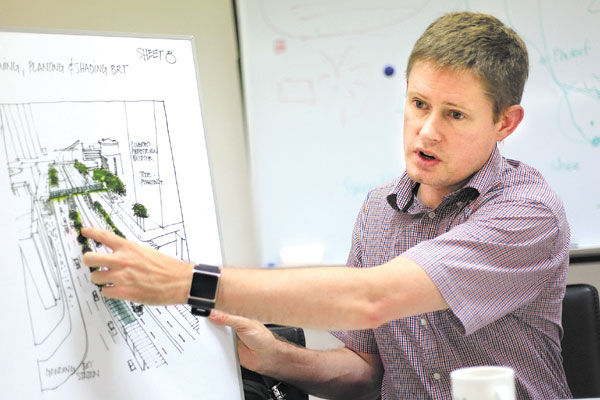
Karl Fjellstrom displays his design sketch of Guangzhou's Bus Rapid Transit system. Photos by Zou Zhongpin / China Daily |
 |
|
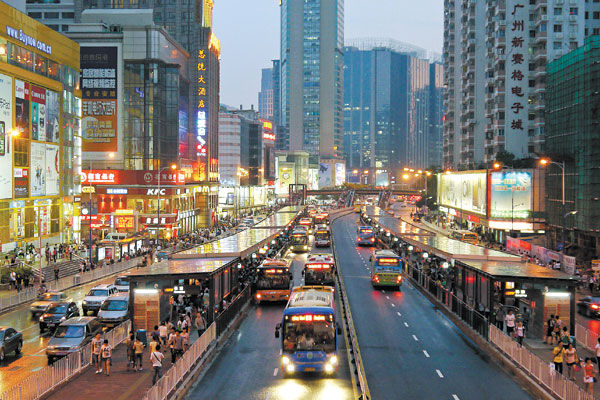
Guanghzou's BRT helps 800,000 people travel daily. |
He is happiest looking at traffic as it hums smoothly along a major thoroughfare in Guangzhou, Guangdong province. Xu Jingxi talks to the man responsible for helping cure congestion in the city.
It used to be a nightmare taking a bus across Gangding, a downtown area full of IT malls, office blocks and hotels in the Tianhe district in Guangzhou. Buses fought against cars coming out of parking lots just to approach their bus stops. They would edge along the road caught in the lines of cars traveling at snail's pace in the gridlock.
Guangzhou, capital of Guangdong province, is one of the fastest growing cities in China. Like other major metropolises in the world, it was plagued by traffic gridlock, but unlike some other cities, it seems to have found a solution. The key is the city's Bus Rapid Transit (BRT) system.
The first BRT line opened in February 2010, along Zhongshan Avenue in Gangding, where the central lanes have become dedicated bus lanes, and BRT stops have been moved from the side to the middle of the avenue.
Now BRT buses whiz along the bus lanes, partly clearing the way for cars along the sides, which are also moving at a more efficient speed with the orderly flow of traffic.
Karl Fjellstrom is the lead expert on Guangzhou's BRT. The 40-year-old Australian expert on public transport planning was invited to Guangzhou in late 2004 to design the city's first BRT line. It was a tough start.
"People were worried because Guangzhou's BRT is a big project with many innovative designs. They did not understand that a bus is justified in having priority on the roads because it carries more people than a car. A city's transportation planning should be people-oriented rather than car-oriented," he says.
"I knew the BRT would succeed, and if anybody asked me, I told them it would be a big success. Time would tell."
It did, and the BRT now helps 800,000 people travel better daily.
Fjellstrom's confidence in the project was based on his team's rigorous design, supported by a huge amount of data.
"Karl is scrupulous about work. He told us to count the buses that stopped at the stations one by one, over a given period of time, and how many passengers got on and off each bus," says Li Wei, Fjellstrom's colleague at the Guangzhou Modern BRT and Sustainable Transport Institute, the China office of the international non-governmental organization, Institute for Transportation and Development Policy.
Li spent two years collecting data during the morning and evening peak hours, counting numbers in the traffic fumes.
"I was tired but I was ashamed to complain when Karl always arrived at the bus stop earlier than me and would stay late in the office analyzing the data until midnight," Li says.
The six years of hard work by Fjellstrom's team paid off. Guangzhou's BRT gradually won the hearts of local residents and also impressed the world.
As the first BRT anywhere to feature direct connecting tunnels from BRT to the city's metro stations, and the first to include bicycle parks and a bike-sharing scheme in the station design, it won the 2011 Sustainable Transportation Award by the United States Transportation Research Committee.
It is also the world's first high-capacity "direct-service" BRT system, in which BRT buses operate both inside (at BRT stations) and outside (at regular bus stops) the BRT corridor.