Falling in love with Detian
 |
|
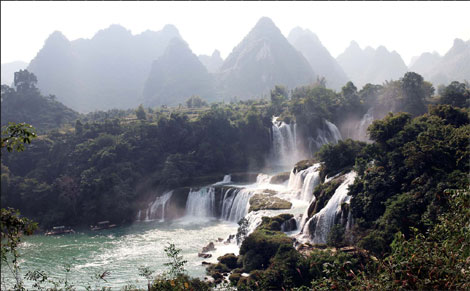
The Detian Falls spread like a sparkling water curtain on the border of China's Guangxi Zhuang autonomous region and Vietnam. Photos by Huo Yan / China Daily |
 |
|
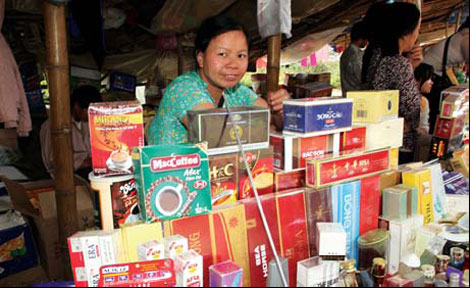
A wide range of Vietnamese products are sold in a local market. |
Guangxi's Detian waterfall borders Vietnam and its neighboring Ban Gioc Falls. Sun Li takes a bamboo raft and explores further.
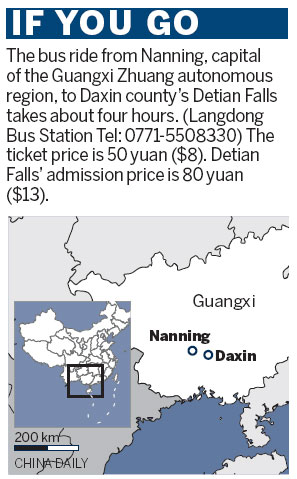
For travelers interested in waterfalls off the beaten track, Detian Falls is a choice destination.
The spectacular and humbling sight of the falls is boosted by a unique setting in the Guangxi Zhuang autonomous region's Daxin county.
Detian Falls, together with the neighboring Ban Gioc Falls on the Vietnam side (both flow into the Guichun River), is Asia's largest transnational waterfall, straddling the border between China and Vietnam.
Summer crowds to the tourist site can be overwhelming. So, if possible, visit during the cooler seasons. You can't go wrong in the autumn, when the attractions are adorned with brilliant green squares of terraced rice paddies.
On windless days, if you listen carefully, you'll hear the falls announce their presence miles away. At first, it is a dull watery whisper.
When you spot the tiered cascades in the mist from afar, you may be eager to feel the roar at close range as quickly as possible. But it's best not to rush.
Instead of walking on the sightseeing route that runs along the river, I took a bamboo raft, which costs 20 yuan ($3) per person and offers a pleasant prelude of cruising on the green waters before reaching the climax of the journey.
Lined with lush, subtropical shrubbery, the river glints in the sunlight, creating a tranquil counterpoint to the distant plummeting cataract, the whisper of which grows into a thunder as you gradually approach.
Draping over rocks on the river's left side, Ban Gioc Falls is comparatively small. If Detian Falls is a robust muscular man, Ban Gioc Falls looks like a shy, slender girl.
It's a pity that you cannot steer the raft to the shore and directly embrace the full beauty of Detian Falls' Vietnamese sister. But if you really want, remember to prepare the proper documents, so you can cross the border later.
Competing for tourists' attention along the way are Vietnamese peddlers who row bamboo rafts and sell a variety of goods.
They speak fluent Mandarin and English, and swiftly punt toward tourists to sell brand perfumes, such as Chanel and Gucci, for the astonishingly cheap price of 20 yuan ($3) per bottle.
Most tourists, however, choose to buy Vietnamese cigarettes and exotic chopsticks made of fine wood.
After a roughly 15-minute ride, you will get so close to the falls that you are likely to get drenched, so wearing a raincoat is advisable.
Detian Falls is massive. It is more than 200 meters wide and drops for more than 70 meters. Clear streams cascade from high in the forest, fanning out over a broad stone cliff.
The waterfall is divided into three tiers, and every tier has a different charm.
While the highest tier sprays mist, unfolding the first scene with dreamy effect, the middle tier's streams have a soft rhythm. The lowest tier's water gushes into a pool, with the light glistening off the spray, sometimes capped off by dazzling rainbows.
Standing in front of the liquid curtain, it is easy for travelers to ponder the smallness of their day-to-day lives and wish they could inspire themselves in this way more often.
After seeing the waterfall, don't be in a hurry to leave. There are still two other sites worth checking out.
Following the sightseeing trail and walking up further into the forest, you will find another cluster of hawkers selling a wider range of products, such as Vietnamese coconut candy, coffee and tanks made from rifle cartridges.
Not far from the market is a landmark known as the Chinese-Vietnamese No 53 Boundary Marker, which was built in the late Qing Dynasty (1644-1911).
It's said that the current location of the boundary mark was decided by two soldiers, who were too tired to carry the marker any further.
Today, it is a popular place for visitors to take photos, as you can visit another country by just shuffling a couple of steps.