Hangzhou: paradise revisited
 |
|
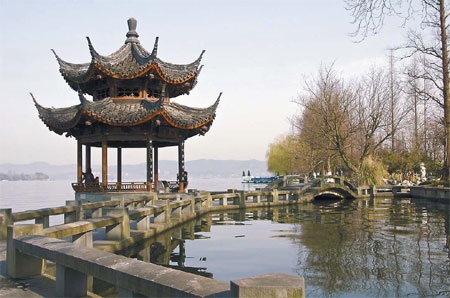
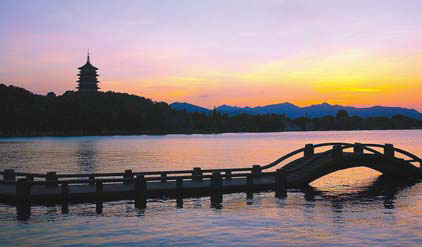
Old pavilions and stone bridges dot the bank of West Lake in Hangzhou, Zhejiang province. Tuweimei |
 |
|
Su Causeway is one of two historic causeways to divide West Lake into three parts. Zhu Yinwei / for China Daily |
 |
|
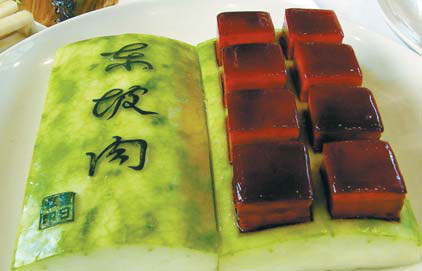
Dongpo Pork is one of Hangzhou's trademark dishes. Jing Wei / for China Daily |
Xu Xiaomin discovers a slice of heaven tucked away close to West Lake.
Paradise means something different to everyone. To some it's a secluded beach with pristine white sand and crystal blue water. To others it might be a high on a mountain overlooking a vast landscape. To this Shanghai dweller it is definitely Hangzhou. But in recent years, every time I went to my paradise, I found it was overrun with noisy visitors, crowding the beautiful lakeside and resembling the Bund in Shanghai.
This winter, after a heavy snow, I went to Hangzhou again. To my surprise, the cold weather seemed to frighten the visitors away. The entire West Lake area was peaceful and quiet. There were many pleasant, unexpected surprises, but Maojiabu, a small village near the lake, wowed me the most and may be my new favorite place in Hangzhou.
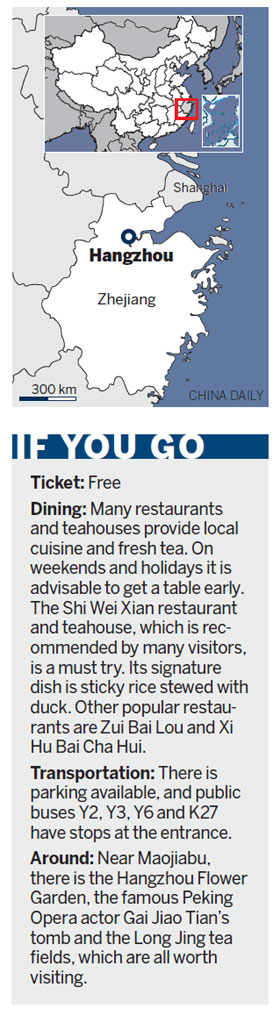
Maojiabu is west of the West Lake near a passage to the Long Jing tea garden and the famous Lingyin Temple. Historical records indicate Maojiabu used to be a dock for shuttle boats between the temple and Hangzhou in ancient times. During Buddhist holidays, it was full of boats and people and teahouses, restaurants and stores grew quickly, like mushrooms on a moist day, around one another. It was a commercial hub in those days.
As roads around the Lingyin Temple were built after the 1940s, the water passage to worship the Buddha was gradually abandoned. Now, Maojiabu has returned to its more peaceful days, where one can enjoy the still water, wild birds, breathtaking sunset and even fresh tea.
I hadn't even read about it before I passed by Maojiabu and came across it by accident when during a stroll along Yanggong Causeway, a tree-lined lake bank parallel to Su Causeway. The huge tea field was what first attracted me.
The deep green tea trees were partly covered by white snow. In the distance there were several gray farmhouses with white walls and black tops. In the center of the field were some tall trees that I couldn't name.
The scenery reminded me of a classic shot in the movie Gone With the Wind, when Scarlett O'Hara's father says in the sunset that land is the only thing in the world worth working for, worth fighting for or worth dying for because it's the only thing that lasts.
But it is strange to me that in most beautiful places in China, no matter how isolated they are, there are always young people taking wedding photos. Maojiabu's tea field is not exempt from this trend. Beaming brides wore ornate gowns and smiled happily in the freezing wind as if they were bathing in warm sunshine.
Be careful when you walk through the tea fields. It's not slippery passages you need to watch out for but dogs running to and around you from every direction.
Opposite to the tea field is the village that has been refurbished and updated but holds on to its utopian countryside look. Walking through a small passage lined with various restaurants and teahouses, my eyes grew wide with excitement when I saw a very beautiful lake, the Xilihu Lake, a newly developed area in Hangzhou.
In winter, the lake was as still as a mirror, reflecting the shadows of pavilions with unique grass-packed tops, fading willows and the sun. It resembled a Chinese ink painting only with less colors but an equally poetic and artistic conception.
Birds abounded all of a sudden. The treading of human feet resulted in dozens of black birds flying toward the sky. This call and the noise of ruffling feathers was the only sound to break the silence around the lake.
And then a group of wild ducks, which were more interesting than the plain black birds, swam into view. As I threw bread pieces into the lake, six or seven wild ducks swam toward me at an unexpected speed, as if they were equipped with engines in their little bodies. But their table manners were less charming, with each bird snapping and pushing the others to have a nibble of the bread.
I was sad to leave Maojiabu, but know I will return. My memories of holding a cup of tea, sitting in a waterside pavilion and enjoying the warm sunshine remind me of why I feel Hangzhou is my paradise. I hope you find your own paradise there too.