Hemudu site: Living exhibit of Neolithic Age
 |
|
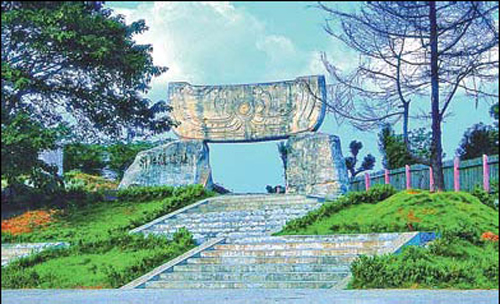
Hemudu Cultural Site Museum reveals the life of a tribe active 7,000 years ago.[Photo/China Daily] |
Exhibits of primitive life are not always confined to a showcase. At the Hemudu Cultural Site Museum in Yuyao city, Zhejiang province, visitors can delve into the wilds to experience a way of life long past.
A replica of wild fields at the site is open to tourists to explore the life of a tribe that was active 7,000 years ago when people hunted wild animals, cultivated rice and fished in the area's rivers and lakes.
Huts and wells dot the meadow where various plants bloom, while timbers and rails remind visitors of the structures of the Neolithic Age. Pillars supporting crossed beams show the mortise and tenon joint techniques used at the time.
Grains, birds and the sun are major motifs in objects discovered at the site. Among the more than 3,000 items from early Hemudu people discovered in the 1970s during excavations is a depiction of a legendary bird of prey spreading its wings
Other items include remains of rice kernels, ceramic fragments with carbonized rice and husks, wooden joints, ivory artifacts in the shape of birds and ivory carved plates with sun motifs.
The field also features a display of family and kinship of the Hemudu people, illustrating that their life may have been primitive, but their affections and emotions were not. Mothers were encouraged to bear more children to make a thriving family, while the fathers worked very hard to harvest grain, hunt animals and spear fish to feed them. Parents took great care to protect their children from the dangers of wild animals.
The Hemudu site has attracted a range of researchers who found that its people turned from gathering wild food to rice farming 7,000 years ago. The people are now recognized as the Hemudu Neolithic Culture by professors Dorian Fuller from University College London and Zheng Yunfei from Zhejiang Provincial Institute of Antiquity and Archaeology.
The Hemudu people eventually domesticated rice, though they might not have been the first, according to Zhang.
The exhibition hall beside the field reopened to the public in 2009 after a 21 million yuan renovation. It now includes displays of relics unearthed from across eastern Zhejiang province.