Professor discovers ins and outs of DIY ventilation
Updated: 2014-02-16 08:35
By Wang Zhenghua in Shanghai(China Daily)
|
|||||||


Home air purifier sales and prices have soared to sky-high levels in pace with China's air pollution.
But Chen Liangyao has taken a different - and seemingly cheaper - tact.
The Fudan University professor has developed a do-it-yourself ventilation system that improves indoor air quality.
It's his solution to the fact that studies show shutting the windows doesn't keep all the smog out on heavily polluted days. Yet people are advised to stay indoors when the smog is thickest.
A plus is that Chen's setup also clears odors that hover when the windows are closed.
The 63-year-old Department of Optical Science and Engineering professor spent 7,000 yuan ($1,500) to install the system in his Shanghai apartment in 1999.
That was long before the Shanghai Environmental Monitoring Center's air quality index that measures pollution surged to a record 482 on Dec 6 of last year.
"It allows fresh air in but blocks small particles," he explains.
Chen's invention has captured media attention.
But he believes he's simply a step ahead of where we're all going - or at least should be.
"Every member of and force in society should advance indoor air quality," he says.
"All new residences should be built with a proper air-ventilation system. We can prevent respiratory diseases this way."
Chen got the idea when he studied in the United States. Ventilation systems are common in US houses but rare in China, he explains.
But China could arguably benefit more from them, considering its extreme air pollution.
So Chen decided to revamp his three-bedroom apartment near the Shanghai Railway Station when he moved in.
Workers followed his design to build four air outlets and intakes in the ceiling and furniture in the dining hall and three bedrooms. The main opening is in the southwestern bedroom.
The ducts are dotted with small holes and filters at their ends. Two motors over the bathroom expel air every two hours, using a timer in the shoe cabinet in the doorway.
Chen also installed PVC windows over the original windows, cutting down not only air pollution but also noise.
The materials cost 2,000 yuan. That's for 20 meters of PVC piping ranging from 10 to 15 cm in diameter, a timer, two silent motors and filter traps.
The rest went to paying laborers to install the system.
The facilities aren't visible. They're concealed in the interior design well enough that a visitor wouldn't know they were there unless told so.
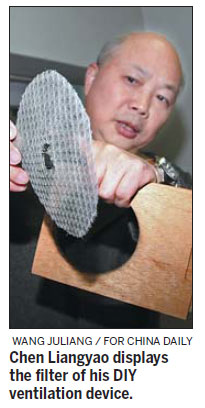
Chen demonstrates the system by placing tissue on one of the intakes. It sticks.
"If someone smokes in here, the odor will disappear very quickly," Chen says.
Chen's system has inspired others to revamp their homes, including not only his friends but also a European who read media reports about it. The man contacted Chen for instructions.
"I told him how to install the system, and he hired workers to do it," Chen says.
Chen is among a growing number of grassroots designers in China who are creating innovative and DIY solutions to smog. But he stands out in that many tinkers are focusing on filtration - i.e., high-efficiency absorption filters taped to the fronts of fans - rather than ventilation.
Some environmental experts have expressed doubts Chen's system could filter out PM2.5 - particles with diameters smaller than 2.5 microns that the respiratory system can't block.
The World Health Organization recently named air pollution, and especially PM2.5, as a leading environmental cause of cancer deaths.
Chen says more tests need to be done to answer the small particle question.
But he points out his system is cost-effective.
"Only purifiers used by the semiconductor industry can completely filter PM2.5," he explains.
"But they're very expensive. Installing those in homes would be like using a cannon to blast a mosquito. We need more research on which filters effectively fight PM2.5 so we can clear these particles from our homes."
wangzhenghua@chinadaily.com.cn
(China Daily 02/16/2014 page3)