Countries urged to share environmental strategies
Updated: 2013-12-15 08:12
By Wu Wencong in Langfang, Hebei province(China Daily)
|
|||||||


Environmental cooperation among China, Japan and the Republic of Korea largely comes from technological development and city-level experience sharing, the countries' environmental experts said on Saturday.
"Officials from seven regions in Japan have applied to share their pollution-alleviation experiences with Chinese cities, and we are seeking more partner cities to cooperate with," the Institute for Global Environmental Strategies' Beijing office director Hideaki Koyanagi said.
He was speaking at a group consultation to discuss solutions to China's air pollution, organized by the China Center for International Economic Exchanges and two other organizations from Japan and ROK, in Hebei province's Langfang city.
Environmental cooperation between some Chinese and Japanese cities has already started. China's Xi'an and Japan's Kyoto, for example, have a mechanism in place.
Beijing officials also traveled to Tokyo in October to learn about the Japanese capital's experience combating air pollution, Japan's ambassador to China Kitera Masato said.
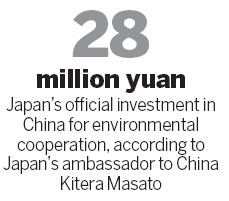
He said Japan's official investment in China for such cooperation has totaled 28 million yuan ($4.6 million).
Minister of the embassy of ROK in China Cheong Yong-rok said East Asian countries should work together to shorten the time needed to tackle the region's air pollution and create more opportunities for the three countries' environmental industries, as the United States and Canada did in the 1990s, and the European countries did in the late 1970s.
Experts attending the group consultation also pointed out the high potential for non-official participation among the three countries, such as technology transfers among enterprises.
"A major problem now is the difference between the price offered by Chinese enterprises and the price Japanese companies can accept, which sometimes stops the cooperation," Koyanagi said.
For example, he said, a Chinese company showed interest in a certain type of technology after visiting a Japanese company. But the Chinese company may only be willing to pay 1 million yuan for the new technology, whereas the Japanese company may have spent 10 million yuan on it.
Koyanagi, who has been in China for 18 years, also expressed concerns about the Chinese government's bold targets to ease air pollution - a 25 percent decrease in the level of fine particles in the Beijing-Tianjin-Hebei cluster in 2017 compared with the 2012 level.
"It took Japan 50 years to solve our air pollution," he said.
"But I admire the Chinese government's ambition and look forward to the result."
Some Chinese experts, though, said Japan took so long to fight air pollution because it did not then have the technology.
The most advanced technology to remove dust can trap 99.8 percent of the particulate generated during the production process.
"It is technologically possible to make real changes in three to five years, but only if we're willing to pay the costs," China Center for International Economic Exchanges deputy director-general Zheng Xinli said.
wuwencong@chinadaily.com.cn
(China Daily 12/15/2013 page3)